By The Maple Team

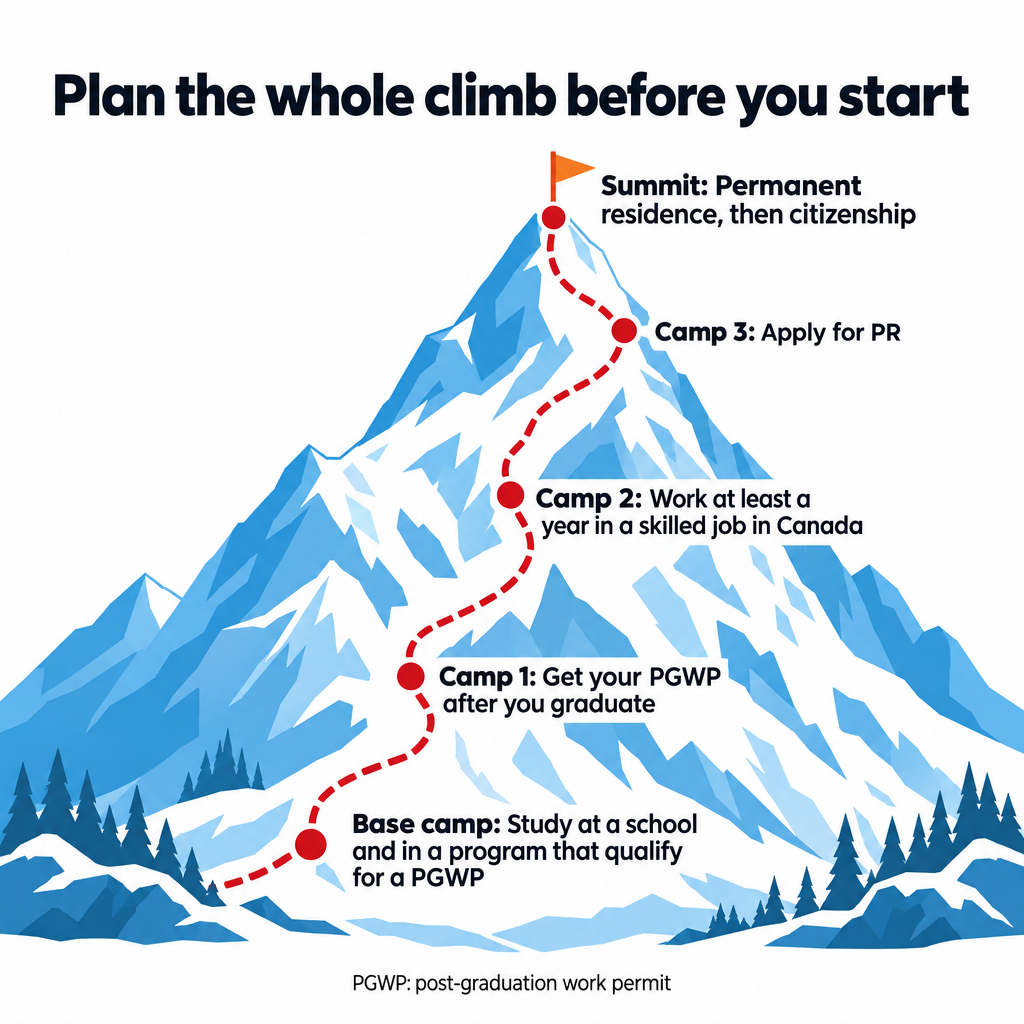
Studying in Canada can lead to permanent residence (PR), but a study permit won’t get you there on its own. The usual route has four steps: you study, you get a work permit when you graduate, you work in a skilled job in Canada for at least a year, and then you apply for PR. While that seems like a simple pathway (and it is), you must be prepared and know how to execute the plan properly and at the right time given your current situation.
Not every school or program qualifies for that work permit after graduation. That work permit is the usual way graduates get permission to work in Canada once they finish, and working on it is how they build the Canadian experience the usual route needs. That’s why the whole route needs to be planned before you choose where to study.
International tuition is a big commitment, and nobody wants to pay for a program only to find out later that it doesn’t lead to PR, or that the rules changed partway through. At Maple Immigration Services, we’ve been in practice for over 15 years. The route from a study permit to a post-graduation work permit (PGWP) to PR is one of the core routes we guide students and their families through. Brandon Miller, the Regulated Canadian Immigration Consultant (RCIC) who leads our team, starts planning it with students before they’ve applied to a single school.
What are the steps from a study permit to PGWP to PR?
The route from a study permit to PR currently runs through four steps, and each one depends on the one before it:
- Study at a school and in a program that qualifies for a PGWP. The PGWP is the work permit that lets you stay and work in Canada after you finish your program.
- Get your PGWP after you graduate. Your program sets the longest the permit can last, which matters because that time is when you build your Canadian work experience.
- Work for at least a year in a skilled job in Canada. This Canadian work experience is what qualifies most graduates for PR.
- Apply for PR. Most people apply through Express Entry, the federal system for skilled workers. Some apply through a provincial program instead, where a province nominates people it wants to settle there.
Treat these four steps as an outline rather than a complete checklist, because your own history will add steps to it, and you must always personalize your plan if you want to succeed.
How long does it take to go from a study permit to PR?
The whole route takes at least as long as your program, plus a year of full-time skilled work, plus the time the government takes to process your applications. If you work part-time, building that year of experience takes longer, and while part-time experience and multiple jobs can keep you on track, you must be sure that they fit your plan. Express Entry also only lets you apply for PR once you’ve been invited, and nobody can tell you in advance when that will happen, so we cannot predict the timeframe. The reality is that no one can, but we can make some very educated guesses based on key data and indicators.
Why plan for PR before you choose a school?
Planning first matters because by the time a lot of students start thinking about PR, the choices that decide it have already been made. “The planning for permanent residence needs to happen prior to any type of study permit or program selection or anything,” Brandon says. “If the goal is to get permanent residence as an add-on effect, that needs to be sorted out from the beginning, and this is the biggest mistake that I see.“
He compares it to climbing a mountain. “If you’re going to summit Mount Everest, you don’t just make a plan from one camp to the other,” he says. “You have a full plan prior to starting the journey and getting to the top of the mountain. You don’t get to base camp 3 and be like, ‘Okay, so what do we do now?'”
The trouble with skipping the plan is that nothing goes wrong at first:
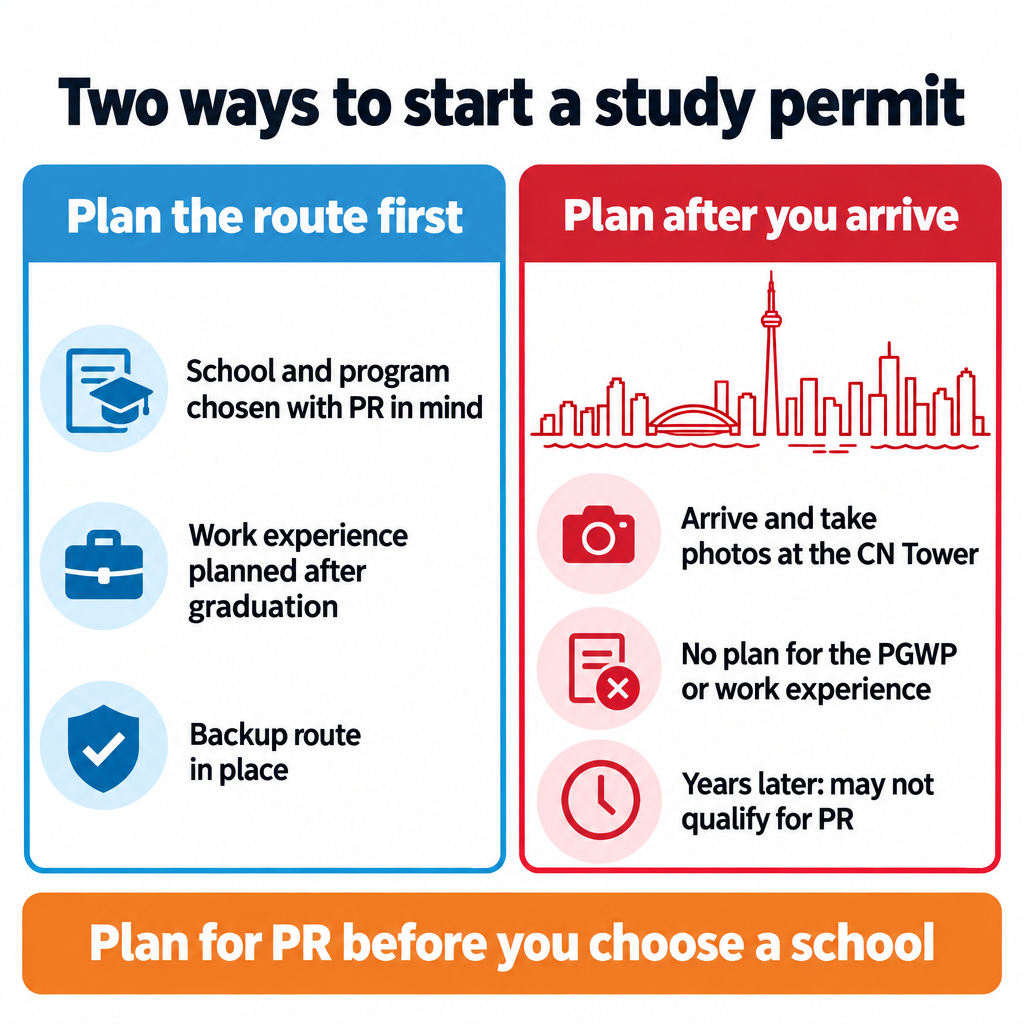
When Brandon works with a student, he plots out the whole route before the study permit or the program is chosen. That plan has to be built on your own facts. Even if you’ve read about someone else’s route online, there are many factors that will make yours different, and a plan that worked for a friend can depend on rules that don’t apply to you.
Which schools and programs lead to a post-graduation work permit?
A program leads to a PGWP only when both the school and the specific program qualify. You can check both before you apply, and Brandon treats them as a pair: “You have to make sure that you select the right type of school that qualifies for the ability to get a post-grad work permit, and you’re also in a program that allows you to do that.”
International students have to attend a Designated Learning Institution (DLI), which is a school approved to host international students. Only some DLIs offer programs that lead to a PGWP. Immigration, Refugees and Citizenship Canada (IRCC), the federal immigration department, keeps a list of DLIs with a section for schools that offer PGWP-eligible programs. That section also names the eligible programs at each school, and IRCC notes that “not all programs offered by a DLI are eligible for a PGWP,” so check that your specific program is listed, not only the school.
Under IRCC’s current PGWP rules, a school and program have to meet at least these points:
- The school and the program are both on IRCC’s list. The school appears in the PGWP section, and your program appears among its eligible programs.
- The program lasts at least eight months (900 hours in Quebec).
- You can study full-time every semester. Part-time study is currently allowed only in your final semester.
- It isn’t a curriculum licensing program, where a private college teaches a public college’s curriculum. These programs are generally not eligible.
- A non-degree program’s field of study is on IRCC’s eligible list.
Treat this as the usual minimum rather than a complete list, because your own situation may add checks of its own.
Two more choices aren’t IRCC rules, but they make the route to PR easier:
- Choose a program of at least a year. A program of eight months to under two years can give you a PGWP of up to the length of the program, so a program shorter than a year means a PGWP shorter than a year. That permit can end before you build a full year of full-time work. A master’s degree is different: one lasting at least eight months can give you a PGWP of up to three years.
- Have a backup route to PR in mind. The PR programs you plan to apply through can change or close while you’re studying, so a plan with a second route is safer.
Does my field of study have to be on the PGWP list?
Your field of study has to be on IRCC’s eligible list only if you’re taking a college, polytechnic or other non-degree program, because bachelor’s, master’s and doctoral graduates are currently exempt. The rule covers anyone whose study permit application was submitted on or after November 1, 2024, so it applies to everyone applying now, and your program’s field has to appear on IRCC’s list of eligible fields of study. IRCC has said that for 2026 it won’t add or remove any fields. In other years the list is updated to match the jobs Canada needs workers for, so a field can be added or dropped. If you’re choosing a program that starts after 2026, check the list again before you commit.
Does the study permit cap affect my school choice?
The study permit cap can affect your school choice, because a master’s or doctoral program at a public DLI currently lets you skip a step most other students have to take. The cap is a yearly limit on the number of study permits Canada issues, and under it, most applicants need a Provincial Attestation Letter (PAL) from the province where they’ll study before they can apply for a study permit. Since January 1, 2026, master’s and doctoral students at public DLIs have been exempt from needing a PAL (IRCC).
Applying for the study permit itself is covered on our study permit page. If you’re in the United States, you can often apply at the border, and our post on why the study permit process can be faster for US students explains how.
How long is a post-graduation work permit, and what limits it?
Your program sets how long your PGWP can last, and a PGWP currently lasts anywhere from eight months to three years (IRCC):
| Your program | How long your PGWP can be |
|---|---|
| 8 months to under 2 years | Up to the length of your program |
| 2 years or longer | Up to 3 years |
| A master's degree of at least 8 months (not a certificate or diploma) | Up to 3 years, even if the program is shorter than 2 years |
Three other rules currently limit the PGWP:
- You can only get one. IRCC calls the PGWP “a one-time opportunity for international students,” and you can’t get another one after a later program (IRCC Help Centre).
- You have 180 days to apply. The 180 days start when your school confirms you’ve completed your program. Your study permit also has to have been valid at some point during those 180 days.
- Your PGWP can’t outlast your passport. IRCC says, “Your work permit will only be issued for the period your passport is valid,” so if your passport expires soon, renew it before you apply for your PGWP.
What work experience counts for PR?
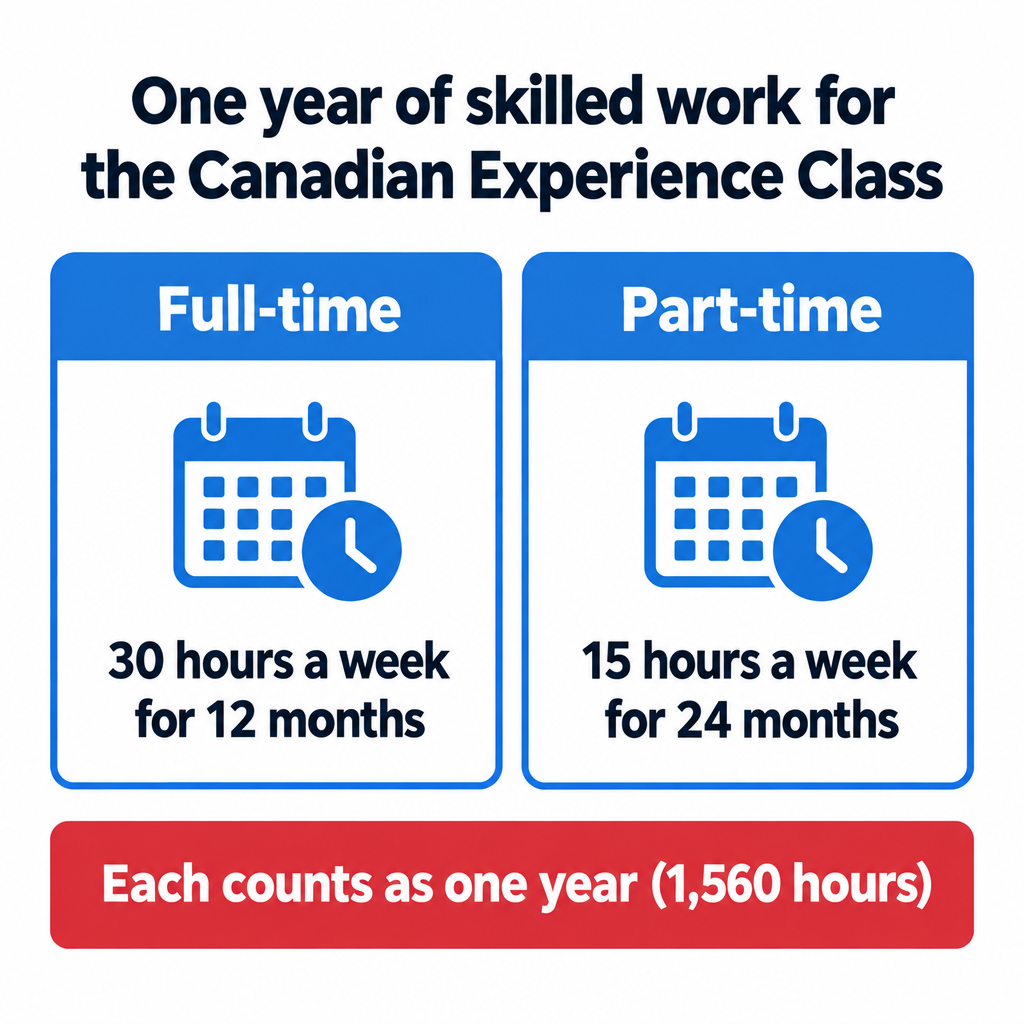
The Canadian Experience Class (CEC) is one of the PR programs managed through Express Entry, and it’s the one built for people with Canadian work experience. It currently requires at least one year of paid skilled work in Canada, which IRCC counts as 1,560 hours, and that year has to fall within the three years before you apply (IRCC). The hours can add up in different ways:
- Full-time: 30 hours a week for 12 months counts as one year.
- Part-time: 15 hours a week for 24 months also counts as one year.
- Several part-time jobs: you can combine them, but IRCC counts no more than 30 hours a week in total.
Importantly, the work also has to be skilled. Canada sorts every job into its National Occupational Classification (NOC). The NOC classifies each job by its Training, Education, Experience and Responsibilities (TEER) level, from 0 to 5, based on what the job requires. To apply under the CEC, you must have worked in a TEER 0, 1, 2 or 3 job, which is what is currently classified as skilled work that qualifies for immigration purposes. IRCC also looks at the duties you actually performed, which have to match the NOC description for your job, so a job title on its own isn’t enough.
Some work currently doesn’t count toward the CEC:
- Work you did while studying full-time, including co-op work terms
- Self-employment (with a narrow exception for some physicians)
- Volunteer work and unpaid internships
- Work you weren’t legally authorized to do
Because work done while studying full-time doesn’t count, a part-time job during your program won’t count toward the CEC either, and your qualifying experience generally builds after graduation, while you’re on your PGWP.
Does my job have to match what I studied?
Your job doesn’t have to match what you studied, as long as it’s skilled work. “One of the biggest mistakes that I see is that people will think that they went to school for this, so they need to work in this,” Brandon says. “In actual fact, they don’t need to do that. They can work in any type of skilled work, and we know it’s skilled work because it has to be a skill level 0, 1, 2, or 3.”
Brandon also points out that the skill level can sometimes be lower: “In some cases, it can be a lower skill level if they’re in a particular program, or maybe some provinces might have some exceptions there.”
What language test scores do you need?
You’ll need an approved language test result for both your PGWP and your CEC application. Your type of program sets the PGWP minimum, so a university program needs a higher score than a college program. In some cases you’ll also take a different test for school than for immigration. For example, when you apply to a school you will most likely need the Academic version of IELTS, but when you apply for immigration you will need the General Training version.
For the CEC, the minimum depends on your job’s TEER level. Minimum scores are set as levels on the Canadian Language Benchmarks (CLB), Canada’s scale for English ability, and the French scale (NCLC) uses the same levels. These are the current minimums (IRCC PGWP rules; IRCC Express Entry comparison):
| Application | Your situation | Minimum score |
|---|---|---|
| PGWP | Bachelor's, master's, doctoral or other university program | CLB 7 or NCLC 7 in all four abilities |
| PGWP | College, polytechnic or other non-university program | CLB 5 or NCLC 5 in all four abilities |
| CEC | Job at TEER 0 or 1 | CLB 7 |
| CEC | Job at TEER 2 or 3 | CLB 5 |
The accepted tests are CELPIP-General, IELTS General Training and PTE Core in English, and TEF Canada or TCF Canada in French. For the PGWP, IRCC says the test should be taken in person, and the results have to be less than two years old when you apply, so if your program runs two years or longer, a test you took before you started will be too old by the time you graduate.
How do you apply for PR after your PGWP?
Once you have your year of skilled work, you apply through Express Entry or, in some cases, through a province, and Brandon builds that choice into the plan from the beginning. “Most people are going to go through a federal program like Express Entry or something along those lines, but some people will go into the province,” he says. “Normally, what we’ll do when we look at that is plot all of this out, while ensuring both pathways are looked at, and strategic backup plans are also in place.”
With Express Entry, you create a profile in an IRCC online account, and IRCC checks which of its programs you qualify for, such as the CEC. The Comprehensive Ranking System (CRS) then gives your profile a score, which ranks you against everyone else waiting in Express Entry. Your Canadian education adds to that score even though the CEC doesn’t require any. IRCC sends invitations to apply for PR, and the candidates with the highest scores are the most likely to get one, but IRCC states that a profile “doesn’t guarantee that we’ll invite you to apply for permanent residence,” and “you can only apply if we send you an invitation.”
Through a Provincial Nominee Program (PNP), a province can nominate you for PR instead, and each province sets its own requirements in separate programs it calls streams. Our team matches each profile to the stream that fits, based on qualifications, work experience and the province’s needs, as our provincial nominee programs page describes.
What changes in Express Entry on November 3, 2026?
IRCC has scheduled a change to the CRS for November 3, 2026, and as of October 21, 2026, it hasn’t taken effect yet. Under the new rules, extra points will go to people with at least 12 months of Canadian work experience in an eligible high-wage occupation, so the job you take after graduation may affect your score as well as whether it counts for the CEC.
What if my work permit ends before PR comes through?
If your PGWP is running out after you’ve applied for PR, you may be able to keep working on a bridging open work permit while IRCC processes your application. You can currently apply for one only if you’re the main applicant on the PR application and you’re living in Canada. You also need valid status: a valid work permit, an expired permit with your status as a worker kept, or eligibility to restore your status. You also have to wait until your complete PR application is in and IRCC has confirmed it received that application. A bridging permit won’t help if your PGWP ends while you’re still waiting for an Express Entry invitation.
Can my spouse be the main applicant instead?
For some couples, the spouse would make the stronger main applicant, and that’s worth working out before either of you chooses a program. Brandon sees couples who find out years later that the spouse “would have been the stronger candidate” and should have been the one to study and add to their CRS score, because they were the better main applicant all along.
Under the current CRS, most of a couple’s points come from the main applicant:
- A main applicant with an accompanying spouse can earn up to 460 points for their own age, education, language and Canadian work experience.
- The accompanying spouse can add up to 40 points for their own education, language and Canadian work experience.
- Someone applying without a spouse can earn up to 500 points for the same factors as the main applicant.
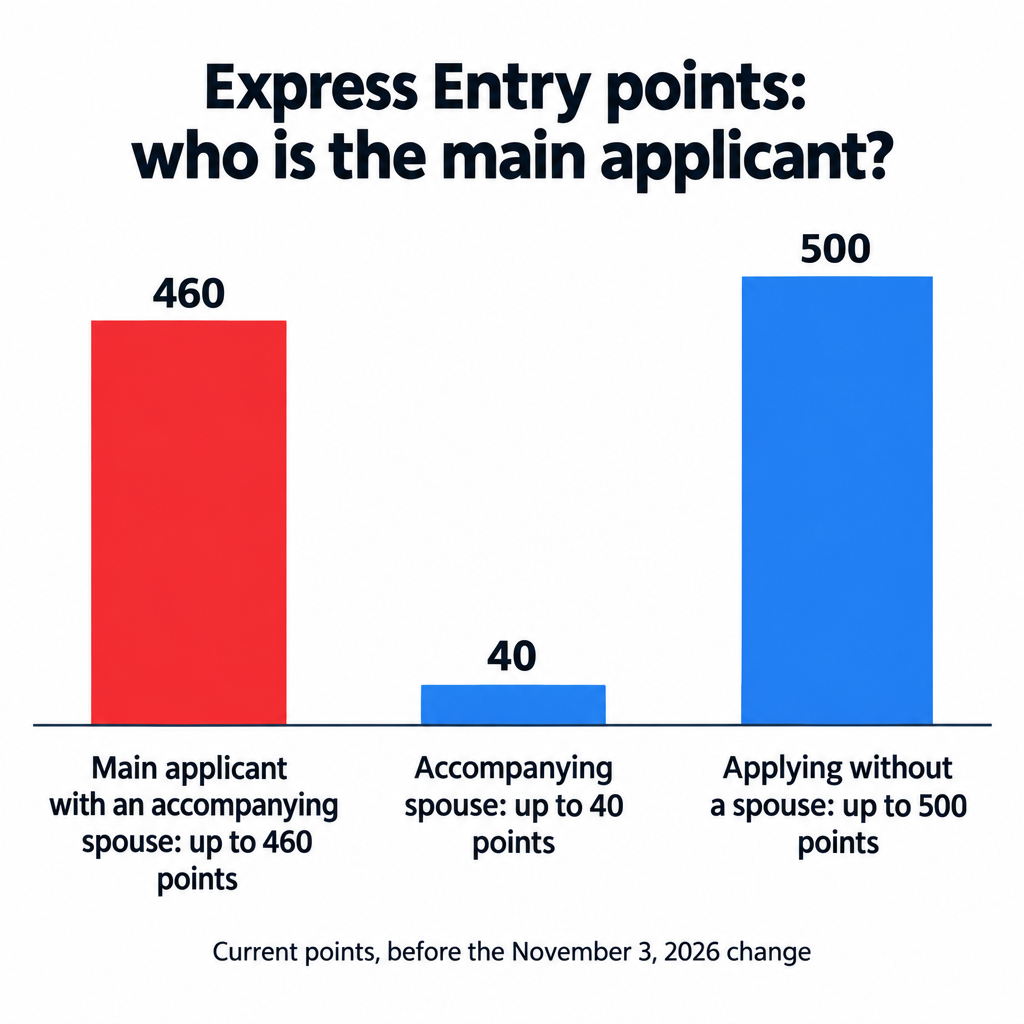
Because of that, the partner with the stronger language results, education or Canadian work experience may score better in that role. These figures are from the system in place before November 3, 2026, and they may change after it. If your spouse wants to work while you study or work in Canada, our spousal work permit page covers who may qualify for an open work permit.
What if the rules change while I’m studying?
Rules can change between the day you choose a program and the day you apply for PR, so your plan needs a backup route from the start. In mid-2026, Ontario closed its Master’s Graduate and PhD Graduate streams, which were built for people with those degrees, along with its Employer Job Offer: International Student stream, all part of the Ontario Immigrant Nominee Program (OINP).
Ontario’s update page names no graduate-specific stream to replace the closed ones. The same page introduces a new Ontario Workforce Priority stream, which gives recent Ontario graduates a shorter work experience requirement in one of its job offer pathways. Anyone who planned around one of the closed streams now has to check whether the new stream or another route fits.
Brandon compares a rule change like this to a storm coming in while you’re partway up a mountain. “You might have to adjust your plans a little bit, but you should be able to do that,” he says, as long as your plan already has contingencies built in.
In practice, a backup might mean choosing a program that keeps you eligible for both Express Entry and a provincial stream, or a program long enough to give you more time on your PGWP if your first route closes or your year of work takes longer to build than planned.
Plan your route before you choose a school
If you or your son or daughter haven’t chosen a school yet, this is the best time to plan, because every option on the route is still open. We’ll look at your full situation and plot out the route from study permit to PR, backup plan included, before you choose a program. Tell us about your situation and we’ll set up a call to walk through it with you.