
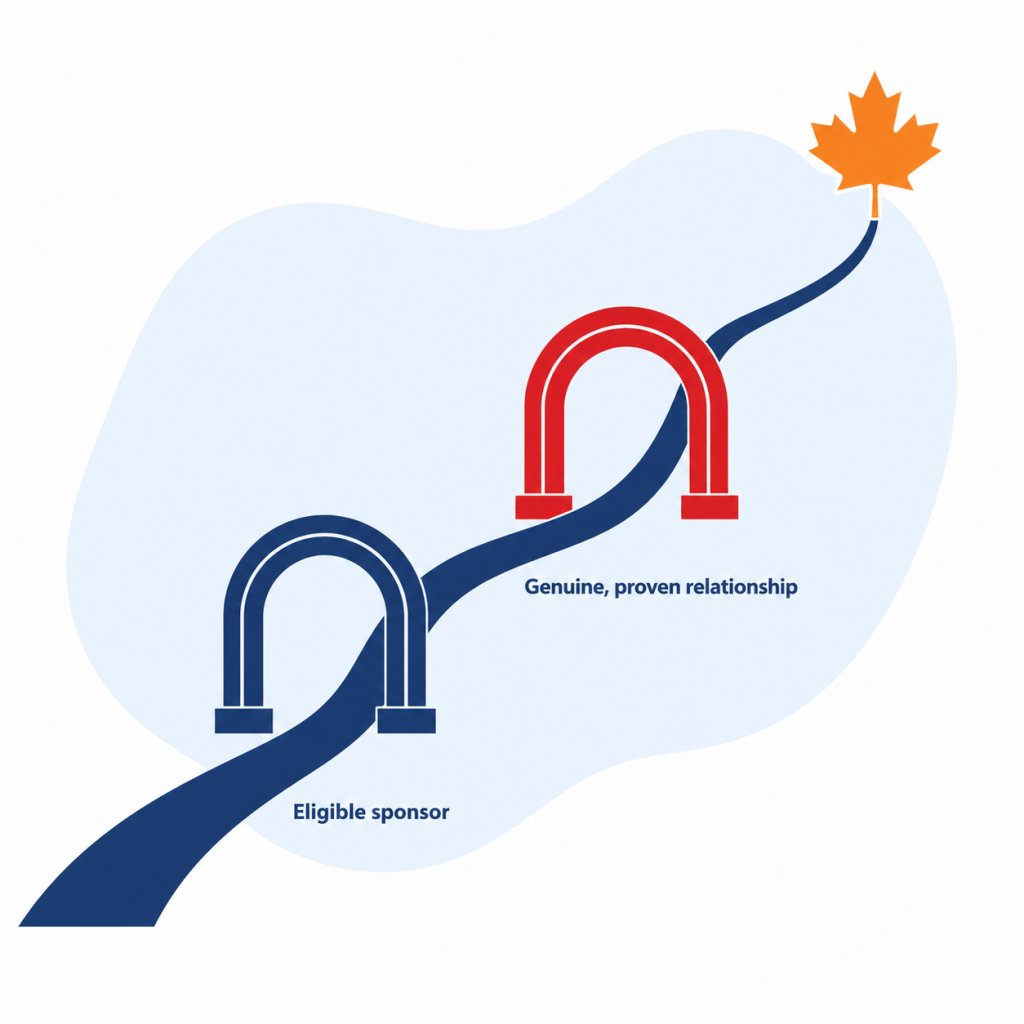
You may be eligible to sponsor your spouse or partner if you are at least 18 and you are a Canadian citizen, a permanent resident, or a person registered under the Canadian Indian Act. You also need to live in Canada, or plan to move back once your partner lands, and you cannot fall under a specific list of disqualifiers. That is the sponsor side of the test, but there is a second side that surprises a lot of people: even when you qualify as a sponsor, Immigration, Refugees and Citizenship Canada (IRCC) still has to be satisfied that your relationship is real and that you can prove it.
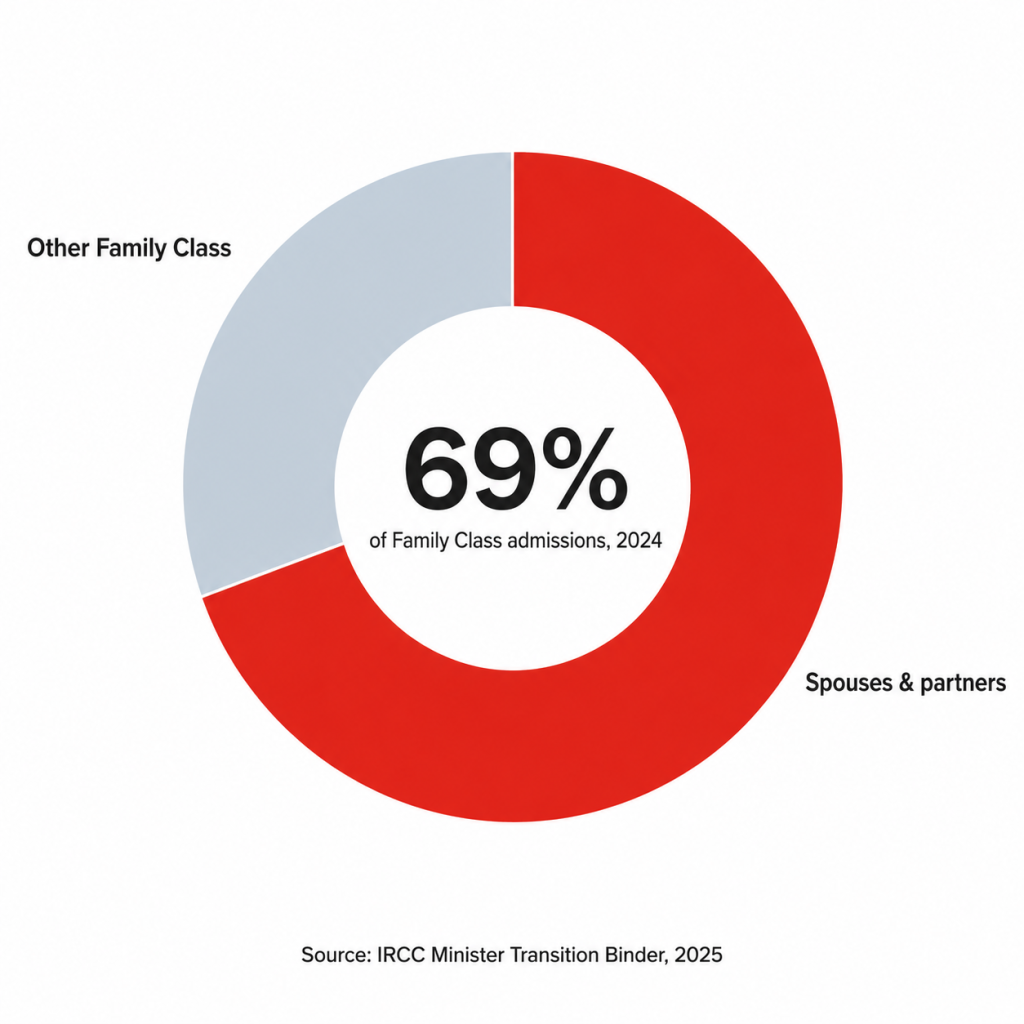
At Maple Immigration Services, spousal and family sponsorship is our flagship area, and it is where we have our deepest experience. Spouses and partners made up roughly 69% of Canada’s Family Class admissions in 2024, so this is one of the most common ways families reunite here. We treat a sponsorship application as a story that has to be told and proven, not a stack of forms, because being an eligible sponsor is the starting point, not the whole case.
The Two Things You MUST Prove
A spousal sponsorship really comes down to two separate questions, and you need a yes to both.
- Are you an eligible sponsor? This is about your status, your age, where you live, and whether anything in your history disqualifies you.
- Is your relationship genuine, and can you prove it? This is about the relationship itself, and it is where officers have the most room to say no.
A lot of Canadian-born sponsors assume the process is simple because their relationship is real. The relationship being real is necessary, but on its own it is not enough. IRCC still has to be shown, with documents, that the relationship is genuine. Keep both questions in mind as you read, because most refusals trace back to one of them.
Who can sponsor a spouse or partner in Canada?
To sponsor a spouse, common-law partner, or conjugal partner, you generally need to meet all of the following:
- Be at least 18 years old.
- Be a Canadian citizen, a permanent resident of Canada, or a person registered in Canada under the Canadian Indian Act.
- Live in Canada, or show that you intend to move back to Canada once the person you sponsor becomes a permanent resident.
- Sign a sponsorship agreement and an undertaking, which means you accept financial responsibility for the person you sponsor.
- Not be receiving social assistance for a reason other than a disability.
- Be able to meet the basic needs of the person you sponsor.
Meeting this list makes you an eligible sponsor. It does not, by itself, get the application approved, but it is the first gate you have to clear.
Can you sponsor your spouse from outside Canada?
This is one of the distinctions that catches people out, and it matters a great deal for Canadians and dual citizens living in the United States.
- A Canadian citizen living outside Canada may be able to sponsor, but only if you can show you plan to return to Canada when your spouse or partner becomes a permanent resident.
- A permanent resident living outside Canada cannot sponsor. You have to be living in Canada.
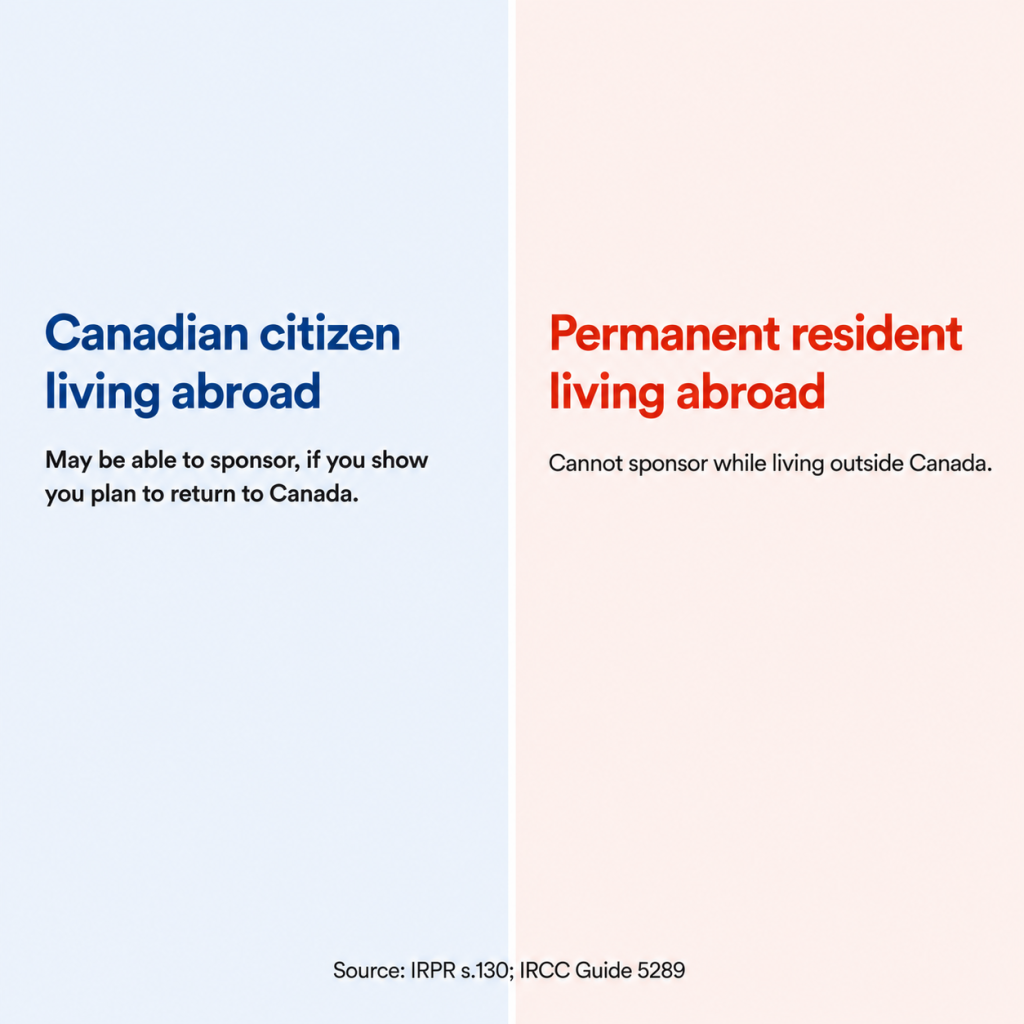
If you are a Canadian citizen abroad, that plan to return is not a box you tick. You may need to back it up with evidence, so plan to show it rather than simply state it. This is hugely important and is one area that we pay particular attention to when preparing applications, as officers will call this out often even when there has been a lot of information supplied upfront.
What disqualifies you from sponsoring?
Some situations make a person ineligible to sponsor regardless of how strong the relationship is. Use this as a quick self-screen. You may be barred from sponsoring if you:
- Are subject to a removal order.
- Are detained in a prison, jail, reformatory, or penitentiary.
- Have been convicted of certain offences, including a sexual offence or a violent crime, particularly against a family member.
- Are in default of a previous sponsorship undertaking, an immigration loan, a performance bond, or court-ordered support payments (such as alimony or child support).
- Are an undischarged bankrupt, meaning you declared bankruptcy and have not yet been released from it.
- Are receiving social assistance for a reason other than a disability.
- Were sponsored as a spouse or partner yourself and became a permanent resident less than five years ago, or have an ongoing undertaking for a former spouse or partner.
If any of these apply to you, it is worth getting your situation reviewed before you spend time and money on an application.
Is there an income requirement to sponsor a spouse?
For most spousal and partner sponsorships, there is no minimum income requirement. However, you still sign a financial undertaking, and you still cannot be on social assistance for a reason other than disability, but there is no income table you have to hit, similar to the ones you will find in other economic programs.
There is one narrow exception. An income requirement can apply if you are sponsoring a spouse or partner who has a dependent child, and that dependent child has dependent children of their own. In that specific situation, IRCC applies a minimum necessary income based on Statistics Canada’s Low Income Cut-Off (LICO). For the ordinary spousal or common-law case without that layered dependency, the income table does not apply. If you want to understand how the numbers work in the situations where income does come into play, we go deeper in our guide on the income needed for sponsoring your spouse to Canada.
What is the sponsorship undertaking?
Sponsorship is not just a formality. When you sponsor, you are making a legal financial commitment, and it is one of the most misunderstood parts of the whole process.
For a spouse, common-law partner, or conjugal partner outside Quebec, the undertaking period is generally three years, starting the day the person becomes a permanent resident. During that time you are financially responsible for them. If the person you sponsor receives social assistance during the undertaking period, you may have to pay it back.
The part that surprises people is how binding the commitment is. Per IRCC’s own sponsorship guide, the undertaking will not be cancelled even if:
- You become divorced or separated, or the relationship breaks down.
- You run into financial trouble.
- Either of you moves.
- The person you sponsored becomes a Canadian citizen.

Once permanent residence is granted, that PR status does not disappear just because a genuine relationship later ends. The undertaking stays in force for its full term regardless of what changes in your life. It is important that you as a sponsor go into this application with the understanding of this commitment before you sign it.
A separate note for Quebec
Quebec runs its own undertaking process. If you live in Quebec, IRCC assesses your eligibility as a sponsor first, and then you sign a separate undertaking with the province through the Ministère de l’Immigration, de la Francisation et de l’Intégration, and your spouse or partner needs a Certificat de sélection du Québec (CSQ). Quebec also sets its own intake limits that open and close, so if you are sponsoring in Quebec, check the current intake status on quebec.ca before you count on being able to apply.
How do you prove your relationship is genuine?
This is the heart of spousal sponsorship, and the part people most often underestimate.
Being an eligible sponsor is only one hurdle. IRCC must also be satisfied that your relationship is genuine and was not entered into primarily to gain status in Canada. Applications that fail here are often described as suspected “marriages of convenience,” but the test is broader than that label suggests. Under section 4 of the Immigration and Refugee Protection Regulations, a relationship can be disqualified if it was entered into primarily for immigration purposes, or if it is simply not genuine. Failing either part is enough for a refusal.
Here is the uncomfortable truth we tell clients plainly. A couple can meet every sponsor requirement, have a completely real marriage, and still be refused if the evidence of the relationship is thin, inconsistent, or incomplete. The assumption that a real relationship proves itself is exactly what sinks otherwise strong cases. Officers do not meet you at your kitchen table. They see a paper file, and they decide based on what is in it.
That is why we approach a sponsorship as a story that has to be told and proven. A strong application does more than state that you are married or living together. It shows how the relationship developed, why it is genuine, and how the documents back that story up. When the dates, addresses, travel history, and paper trail all line up and point the same way, an officer has far less reason to doubt you.
Spouse, common-law, or conjugal partner: which category applies to you?
The rules differ depending on how your relationship is defined. Most people fall into one of three categories.
| Category | Core Requirement | Best For |
|---|---|---|
| Spouse | Legally married to the sponsor, both at least 18, in a genuine relationship, and not inadmissible | Couples with a legally recognized marriage |
| Common-law partner | Have lived together continuously in a marriage-like relationship for at least 12 months | Couples who live together but are not married |
| Conjugal partner | In a committed relationship for at least a year but unable to marry or live together due to barriers beyond their control | Couples kept apart by law, immigration, or similar barriers |
If you are married
To sponsor a spouse, you must be legally married, and the marriage has to be valid for immigration purposes. If the marriage took place outside Canada, it generally has to be legally recognized both in the country where it happened and under Canadian law. You should be ready to provide your marriage certificate along with evidence that the relationship is genuine.
A few situations to watch:
- If either of you was married before, that earlier marriage must have been legally ended before the new one. If a prior divorce was not properly finalized, the new marriage may not be valid for immigration purposes, though you may still qualify as common-law partners if you meet those criteria.
- Proxy, telephone, fax, and online marriages, where one or both people were not physically present, are generally not recognized for Canadian immigration. This matters for couples who married remotely, including some couples separated between Canada and the United States.
- For same-sex marriages performed outside Canada, the marriage must have been legally recognized where it took place and recognized under Canadian law.
If you are common-law
A common-law partner does not need to be legally married to you. For Canadian immigration, common-law generally means you have lived together continuously in a marriage-like relationship for at least 12 consecutive months.
Two things trip couples up here:
- Immigration common-law is not the same as dating, engagement, or simply spending a lot of time together. It also is not always the same as how “common-law” is used for taxes or in provincial law. Having a child together, for example, does not replace the cohabitation requirement for immigration.
- Short, temporary absences can be acceptable if they were for reasons like work, business travel, or family obligations, and the relationship continued throughout. A genuine breakup, though, resets the clock.
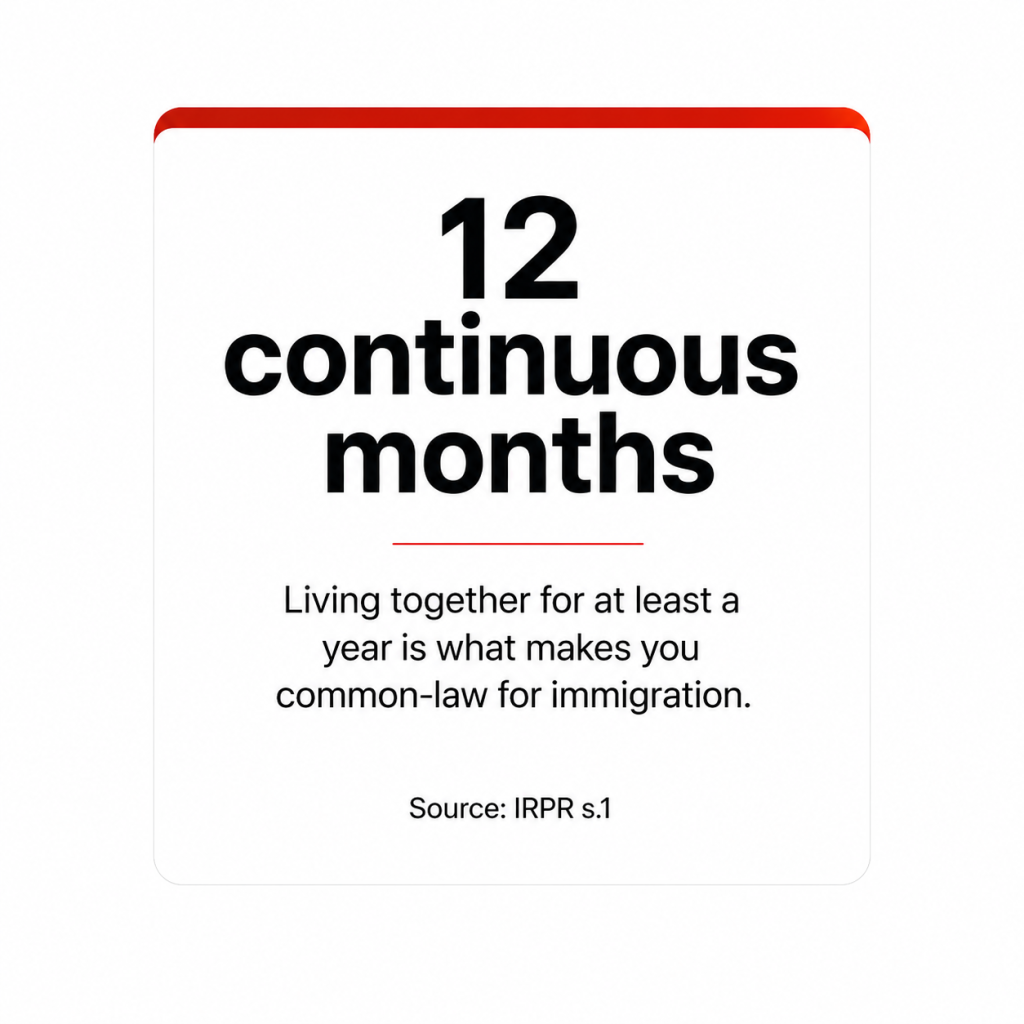
Proof is everything in a common-law case. The 12 months of living together is the single most important thing to document well, so be ready to show it with a consistent paper trail of shared address, finances, and daily life.
If you are conjugal partners
The conjugal partner category is narrower and often misunderstood. It is for a couple who has been in a committed, marriage-like relationship for at least a year, where the partner lives outside Canada, and where marriage or living together was not possible because of a barrier beyond the couple’s control, such as legal restrictions or immigration barriers. If you could have married or lived together and simply did not, this category usually will not fit.
Common reasons spousal sponsorship applications run into problems
Most refusals cluster around a handful of avoidable issues. In our experience, the recurring ones are:
- Not enough proof that the relationship is genuine.
- Missing documents.
- Inconsistent dates, addresses, travel history, or relationship history.
- A prior marriage that was not legally dissolved.
- Weak proof of the 12 months of cohabitation for common-law partners.
- A sponsor who is a permanent resident living outside Canada.
- A sponsor receiving social assistance for a reason other than a disability.
- Problems with a previous sponsorship undertaking.
- Misrepresentation, meaning inaccurate or withheld information, which can lead to a finding that carries a five-year bar from Canada.
- Inadmissibility of the spouse or partner being sponsored, for example due to a criminal record. We cover that specific scenario in our guide on sponsoring a spouse with a criminal record.
The pattern across almost all of these is the same. The application either did not prove what IRCC needed to see, or it contained something that did not add up.
A quick self-check before you apply
Before you submit anything, it helps to confirm three things:
- You qualify as a sponsor. You meet the age, status, residence, and financial requirements, and nothing on the disqualifier list applies to you.
- Your relationship category is correct. You know whether you are applying as a spouse, common-law partner, or conjugal partner, and you meet that category’s specific test.
- Your evidence actually proves what IRCC needs to see. Your documents tell a clear, consistent story of a genuine relationship, not just a marriage certificate or a lease.
If all three are solid, you are in good shape to move forward, but if any of them are shaky, that is exactly where a mistake becomes expensive, and where it is worth getting a second set of eyes before you apply. You can read more about how we handle these cases on our spouse and partner sponsorship page.
Frequently Asked Questions
Can I sponsor my spouse if I currently live in the United States?
If you are a Canadian citizen, you may be able to sponsor from abroad, but only if you can show you plan to return to Canada when your spouse becomes a permanent resident. If you are a permanent resident living outside Canada, you cannot sponsor.
Does living together for a few months make us common-law?
No. For immigration purposes, common-law generally requires at least 12 continuous months of living together in a marriage-like relationship. Dating, engagement, or a shorter period of cohabitation does not meet the definition. You need to be careful as we commonly see different definitions of a common-law relationship under different bodies of legislation.
Can I sponsor a same-sex spouse or partner?
Yes. A spouse or partner can be any gender. For a same-sex marriage performed outside Canada, the marriage must have been legally recognized where it took place and recognized under Canadian law. Same-sex couples facing barriers to marriage or cohabitation may also qualify under the conjugal partner category. We cover this in more detail in our guide on immigrating to Canada with a same-sex partner.
Talk it through with the Maple Team
Spousal and family sponsorship is the work we know best. We are a Toronto-based Canadian immigration consultancy led by Brandon Miller, a Regulated Canadian Immigration Consultant (RCIC) licensed by the College of Immigration and Citizenship Consultants, with 15 years in practice. We handle sponsorship cases for couples across Canada and around the world, including a growing number of applicants based in the United States.
We only take on cases we believe in, and we will tell you the truth about where yours stands. If you want to know whether you qualify, which category fits your relationship, and what it will take to prove your case, tell us about your situation and we will set up a call to walk through it with you.