U.S. citizens and eligible U.S. permanent residents may be able to apply for a Canadian study permit at a Port of Entry (POE), meaning the land border or airport, when they arrive in Canada. Instead of submitting an application online and waiting for a decision, an eligible applicant presents a complete application directly to a Canadian Border Services Officer, who can review it and make a decision on the spot during the entry process. That is why the process can be faster for many American students. The advantage is real, and it is written into Canadian immigration regulations.
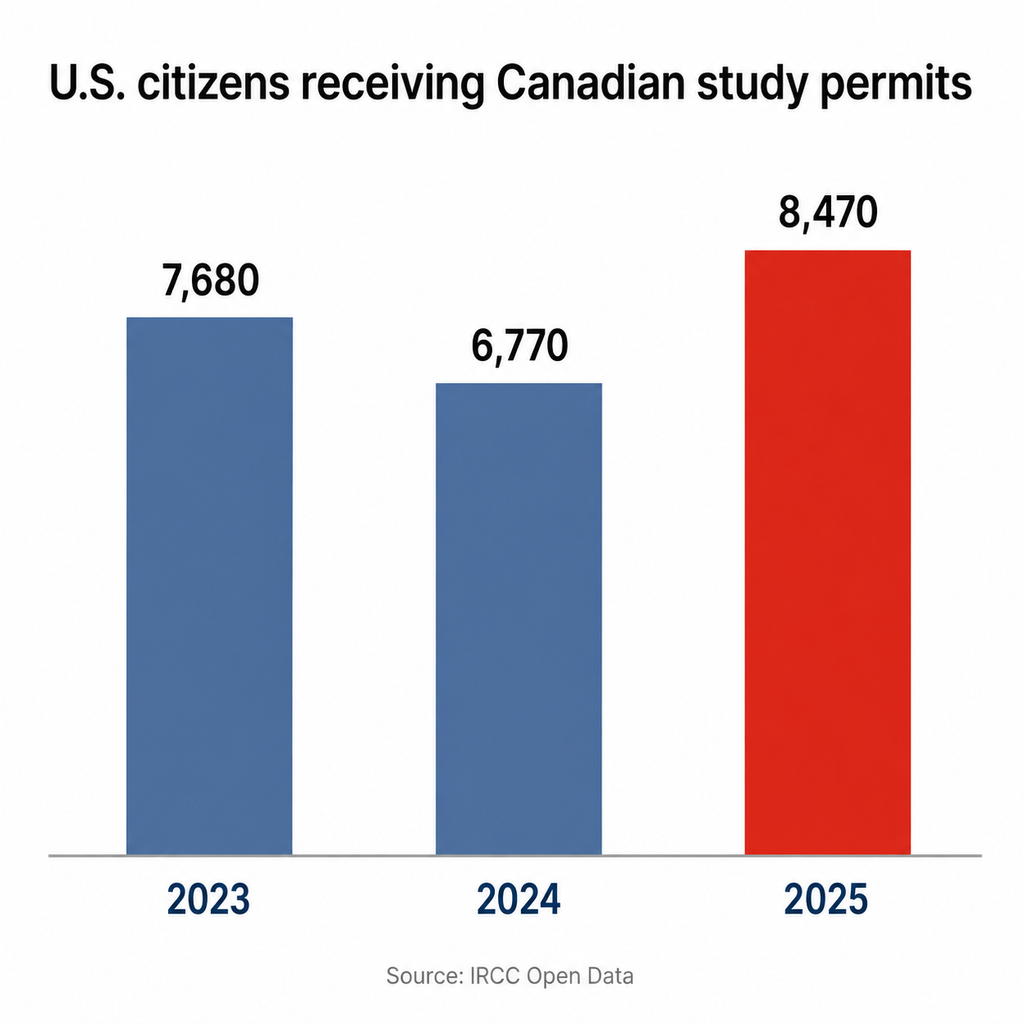
It is also widely misunderstood and fraught with issues if you are not prepared when you apply at the border. At Maple Immigration Services, working with U.S. applicants is one of our core focus areas, and study permits for American students are among the cases we focus on quite regularly. Interest is growing too: Immigration, Refugees and Citizenship Canada (IRCC) data show roughly 8,470 U.S. citizens received study permits that took effect in 2025, up about 25 percent from 2024. Our founder, Brandon Miller, a Regulated Canadian Immigration Consultant (RCIC, CICC #R507745) with 15 years in practice, puts the whole topic in one line: “The border can be faster, but faster does not mean casual.“
This article explains who qualifies for the Port of Entry option, why it can be faster, what you still have to prove, and how to prepare so the speed advantage actually works in your favour.
Who Can Apply for a Study Permit at the Canadian Border?
Section 214 of Canada’s Immigration and Refugee Protection Regulations allows four groups to apply for a study permit when entering Canada:
- Nationals or permanent residents of the United States
- People who have been lawfully admitted to the United States for permanent residence
- Residents of Greenland
- Residents of St. Pierre and Miquelon
For American readers, the practical takeaway is that U.S. citizens and eligible U.S. permanent residents may apply at a Port of Entry. Not every U.S. student automatically can, and eligibility to apply at the border does not waive a single requirement for approval. A U.S. permanent resident must carry a valid passport from their country of nationality plus valid proof of their U.S. status, such as an unexpired green card.
Brandon is direct about the most common misconception we hear: “The biggest mistake is assuming that because you are American, the process is automatic. It is not automatic. You still need to prove the program, the funds, the purpose, and your eligibility.” Put plainly, U.S. citizens and eligible U.S. permanent residents benefit from specific Port of Entry application rules, geographic proximity, and the practical ability to travel directly to Canada. None of that lowers the standard they are held to.
Why Applying at the Border Can Be Faster
The advantage comes down to where the decision happens. An online applicant submits their file to IRCC and waits in a processing queue. A border applicant stands in front of a Canada Border Services Agency (CBSA) officer who can review the file, ask questions, and decide in real time. If the officer is satisfied, the study permit can be issued during the entry process. If not, it can be refused on the spot.
| Factor | Online application | Port of Entry application |
|---|---|---|
| Where the decision is made | IRCC processing office | At the border, by a CBSA officer |
| Waiting period | Posted processing time (about 5 weeks from the U.S. as of late July 2026, per IRCC) | The decision can happen during the entry process itself |
| When you get the permit | Approval letter first, then the permit is printed when you enter Canada | Issued at the border if approved |
| Room to fix problems | IRCC may send requests for more documents, adding time | Very little; concerns must be answered in real time |
| Best suited for | Applicants who want certainty before travelling, or with complicated files | Well-prepared, straightforward cases with complete documents |
As of the time of writing, IRCC’s processing time tool showed a study permit application from the United States taking about five weeks online. That figure changes regularly, and IRCC is clear that posted times are estimates rather than guarantees. But the comparison illustrates the point: a qualified border applicant may avoid a wait currently measured in weeks.
There is one distinction we insist on with our own clients: the border route gets you faster access to a decision, but not necessarily a faster visit. The border stop itself can take hours, and there is no published service standard for how long a border study permit application takes. It also does not compress the slow parts that happen before you travel. Getting accepted at a Designated Learning Institution, obtaining a provincial attestation letter where required, and assembling your financial records take the same time either way.
The border route can also sidestep some frustrations of the online system, such as document upload problems, file size limits, the delays that follow an incomplete submission, and waiting on a letter requesting more information. Do not mistake that for the process being informal or legally easier. A poorly prepared border application can do more damage than a poorly prepared online one, because the refusal happens immediately and becomes part of your immigration history, which can have consequences later on for subsequent applications.
Applying at the Border Is Different From Picking Up an Approved Permit
Almost every international student physically has their study permit issued at the border, because IRCC does not mail permits abroad. An online applicant who is approved receives a Port of Entry letter of introduction, presents it on arrival, and the officer prints the permit.
That student’s application was already decided during the online process, but the final check is conducted by the Border Services Officer at the time of arrival. An eligible U.S. applicant using the Port of Entry option arrives with no advance approval at all and must establish the entire case in front of the officer. Same counter, completely different stakes. As Brandon frames it: “When you apply at the border, you are not just crossing into Canada. You are presenting your study permit application directly to an officer.“
This Option Is Not Flagpoling
This option may be available to eligible U.S. students arriving in Canada, but it should not be confused with flagpoling.
Flagpoling is when someone already in Canada drives to the U.S. border, turns around, and re-enters solely to access immigration services. CBSA ended the routine issuance of work and study permits to flagpolers effective December 23, 2024. CBSA’s announcement does list U.S. citizens and U.S. lawful permanent residents among the limited exceptions, but an exception is not a strategy. Border service levels, traffic, and your individual circumstances can make a deliberate “border run” a poor idea even for someone technically within an exception, and the rules in this area have shifted more than once. (Our earlier article on flagpoling predates the December 2024 restriction, which is a good example of how quickly this area moves.)
The use case this article describes is different: a student genuinely arriving in Canada from the United States to begin a program. If you are already inside Canada and need a study permit, the answer is generally an application to IRCC, not a trip to the border.
Do U.S. Students Still Need a PAL in 2026?
In most cases, yes. Since January 22, 2024, most new post-secondary students have needed a provincial attestation letter (PAL) or territorial attestation letter (TAL) with their study permit application, confirming they have a place within their province’s allocation under the national study permit cap. There is no exemption for U.S. citizens, U.S. permanent residents, or Port of Entry applicants. If your program requires a PAL, you need it in hand at the border, and an application without one will fail unless you fit a listed exemption.
The exemption that matters most in 2026 is for students in degree-granting master’s and doctoral programs at public institutions, who became PAL-exempt on January 1, 2026. Watch the wording carefully, though. A one-year “graduate certificate” at a college is not a degree-granting master’s program, even though it is marketed to graduates. For the classic case we see, a U.S. bachelor’s graduate entering a one-year Canadian college certificate or diploma, the working assumption should be that a PAL is required. Quebec runs its own system using an attestation tied to the Quebec Acceptance Certificate (CAQ).
Timing matters too. IRCC expects to issue about 408,000 study permits in 2026, with 309,670 application spaces available for students who need a PAL. Once a province’s allocation is used up, IRCC stops accepting applications from that province’s schools for the year. Applying early in the cap year is a genuine advantage.
How Much Money Do You Need for a Canadian Study Permit?
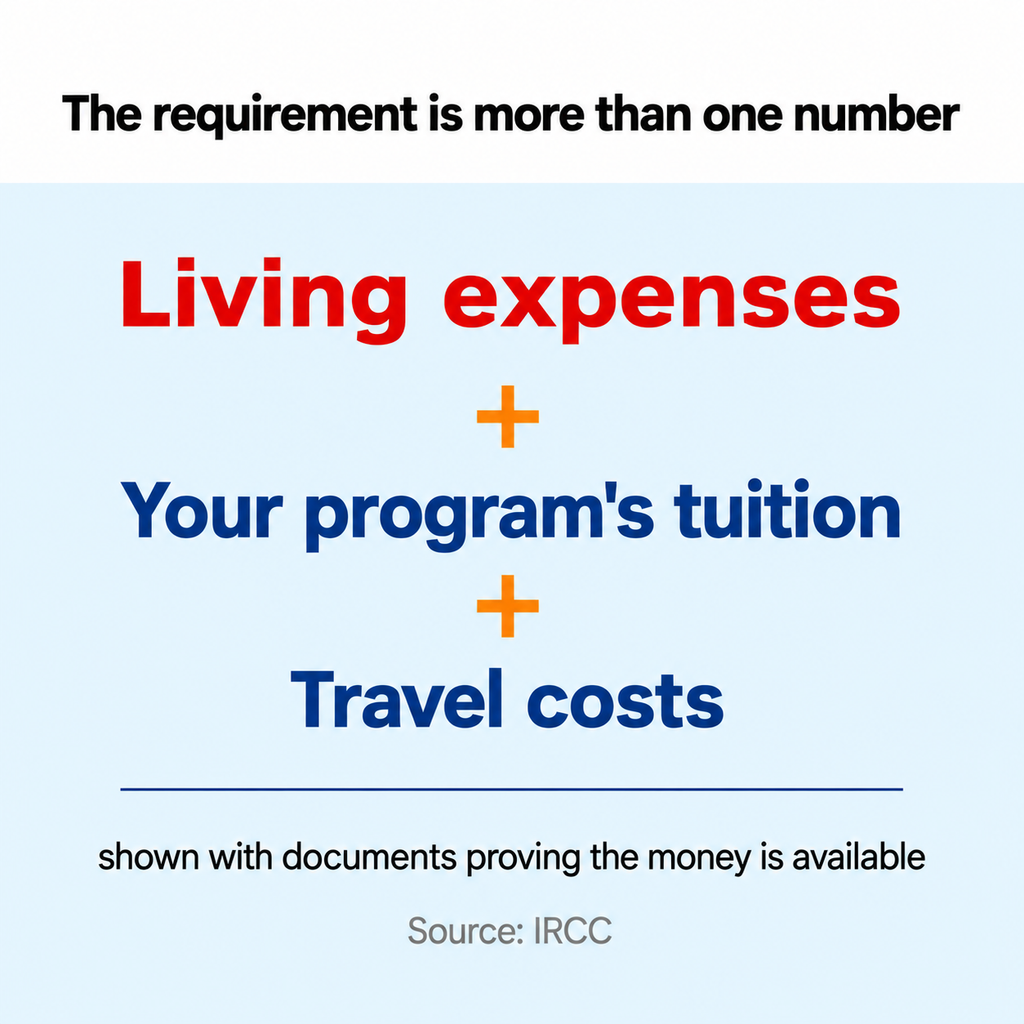
IRCC updates the minimum living-expense figure every year, and the amount that applies to you is the one in force on the day you submit. For applications made on or after September 1, 2026, IRCC currently requires a single student outside Quebec to show at least CAD $23,448 for first-year living expenses, up from $22,895 for applications submitted between January 1, 2025 and August 31, 2026. That figure excludes tuition and travel, so the real requirement is that amount plus your program’s actual tuition plus a reasonable travel budget, with documents proving the money is genuinely available without depending on work in Canada.
| Family size (including you) | Required living funds for the first year (CAD, outside Quebec) |
|---|---|
| 1 person | $23,448 |
| 2 people | $29,192 |
| 3 people | $35,888 |
| 4 people | $43,572 |
| 5 people | $49,419 |
| 6 people | $55,736 |
| 7 people | $62,054 |
| Each additional person | +$6,318 |
These amounts apply to applications submitted on or after September 1, 2026. If you are heading to Quebec, the financial requirement comes from the province’s own rules tied to the Quebec Acceptance Certificate (CAQ) rather than this table.
The amount is tied to Statistics Canada’s Low Income Cut-Off (LICO) and is re-dated each September 1, so budget for it to rise and confirm the figure in force on the day you actually submit. Funds are one of the areas we look at hardest in a student file, because the requirement is easy to underestimate and expensive to get wrong, so show as much as you genuinely have available, and be ready to articulate and document where that money is held and how you are supported.
A note for parents, since parents are often the ones funding and evaluating this plan: “we’ll pay for it” is not evidence. A sponsor letter needs to be backed by proof of the sponsor’s actual resources, such as bank statements and income records. Acceptable evidence generally includes proof of paid tuition or housing, six months of bank statements covering the month you submit or the month before, funds held preferably in a Canadian bank account or a Guaranteed Investment Certificate (GIC), scholarship documentation, or a properly supported sponsor letter. IRCC treats its own list as examples rather than a complete list, and an officer also looks at where the money came from and whether it will still be available to you through your studies, so treat this as the usual minimum for your file rather than the whole of it.
Fees, Biometrics, and the eTA Question for Green Card Holders
The study permit application fee is CAD $150, and IRCC confirms eligible applicants can pay it at the Port of Entry. U.S. citizens are generally exempt from the biometrics requirement for temporary residence. A U.S. green card holder who is a citizen of another country is not automatically exempt and may owe the CAD $85 biometrics fee. That should be sorted out before travelling, not discovered at the counter.
Green card holders flying into Canada face one more wrinkle. IRCC’s general rule since April 26, 2022 is that U.S. lawful permanent residents do not need an electronic travel authorization (eTA) to fly to Canada; they show their passport and green card instead. Yet IRCC’s own instruction page for Port of Entry study permit applications currently states that a U.S. permanent resident applying at an airport must obtain an eTA before boarding. Both statements sit on live government pages at the same time.
We cannot tell you which sentence an airline check-in agent will follow on a given day. What we tell our own clients is the risk-minimizing move: if you hold a green card and plan to fly in and apply, consider obtaining an eTA anyway. It costs CAD $7 and is usually issued within minutes, and holding one removes the risk of being denied boarding before your application ever begins. Carry the passport and green card regardless, because those are required in every scenario. U.S. citizens are unaffected; they need neither a visa nor an eTA for any mode of travel.
This kind of contradiction is also why preparation is a professional discipline rather than a packing list. Spotting where the published rules conflict, and planning around the conflict, is part of what a regulated consultant does.
How to Prepare a Border-Ready Application
A passport and your school acceptance letter are the bare minimum, and arriving at the border with only those is a mistake. The legal requirements are identical whether you apply online or at the border. You must be enrolled at a Designated Learning Institution, prove sufficient funds, be admissible (meaning nothing in your background bars you from entering Canada), complete a medical exam where required, and satisfy the officer that you will respect the limits of your stay. Being American changes where you may apply, however it does not change what you must prove.
There is no official CBSA checklist for a border study permit application, so the list below is assembled from IRCC’s eligibility criteria, its application guide, the PAL rules, and CBSA’s guidance for arriving students. A border-ready file generally includes:
- A valid passport, plus valid proof of U.S. permanent resident status if applicable
- Your letter of acceptance, showing the institution, program, tuition, and start and end dates, in a form the officer can verify
- A valid PAL or TAL (or Quebec CAQ attestation), unless you can clearly document an exemption
- Detailed proof of funds covering living expenses, tuition, and travel
- A concise study plan explaining why this program, how it fits your education and career, and why the timing makes sense
- Evidence of your ties and post-study intentions, such as family, employment prospects, or ongoing obligations
- Records and explanations for any prior refusals, arrests, convictions, or medical issues
- Medical exam proof and biometrics evidence where required
- For green card holders flying in, an eTA, for the reason above
Important: treat that list as an example of the usual minimum, not a complete checklist. When Brandon and The Maple Team assemble an application, there is almost always additional documentation that belongs in the file because of something specific to that applicant’s history or situation. Every application is unique, and it needs its own documentation and evidence to give the officer the necessary context.
Just as important as the contents is the presentation, because the officer reviews everything in real time. Brandon’s standard for our own client files applies word for word here: “A good border application should be organized so the officer can quickly understand who you are, where you are studying, how you will pay for it, and why you meet the requirements.” You should also understand your own file well enough to answer ordinary questions about it without hesitation. The officer is not looking for a rehearsed speech, but your plan has to survive normal scrutiny.
Planning the Border Visit Itself
The visit deserves the same planning as the file. There is no way to know in advance how long a border application will take. It depends on that day’s operations, and your application may need to wait if the CBSA team has more pressing matters. CBSA specifically warns that arriving students may face longer processing while paperwork is completed. Practical steps that stack the odds in your favour:
- Travel on a weekday or at an off-peak time where you can. CBSA flags late August, early September, early January, and the Monday of long weekends as especially busy. This is practical planning, not a guarantee of quick service.
- Check CBSA’s published border wait times and confirm your intended crossing’s hours and services in the Directory of Offices and Services. Not every port offers the same immigration processing at all hours.
- Pick a crossing time when your school’s admissions office is open. If the officer cannot verify your acceptance letter on a weekend or holiday, you may be turned away to try again.
- Keep every document in your carry-on, never in checked baggage.
- If you are flying with a connection, you complete immigration at your first Canadian airport. Leave generous connection time.
- Do not schedule anything important immediately after the border visit.
Check Your Permit Before You Leave the Desk
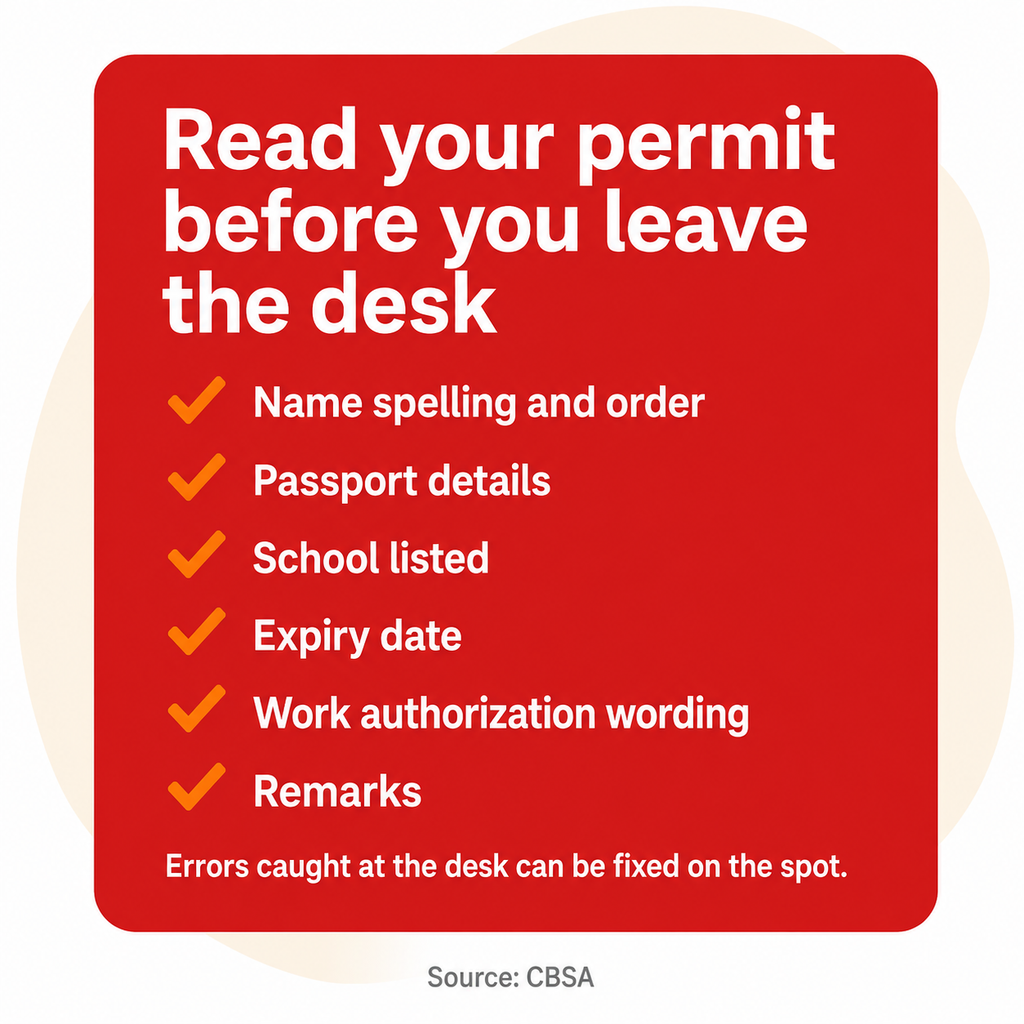
If the officer issues your study permit, review it before leaving the student processing area. CBSA tells arriving students to do exactly this, and Brandon flags it as one of the most important moments in the whole process. Check the spelling and order of your name, your passport details, the school listed, the expiry date, the work authorization wording, and any remarks.
An error caught at the desk can usually be fixed on the spot, however once you walk away, correcting a mistake generally requires a formal request to amend the document through IRCC, a process that can take months at a minimum. The work condition is the line worth reading twice, because an incorrect one can affect your ability to get a Social Insurance Number and work while you study.
When the Online Route Is the Better Choice
Eligibility to apply at the border does not make it the right choice for every student. In our experience, the honest way to think about it is fit.
| The border route tends to suit | The online route tends to suit |
|---|---|
| An adult applicant with a clear, logical program choice | Anyone who wants a decision in hand before committing to travel, tuition deposits, and housing |
| A current PAL or clearly documented exemption | Applicants whose program’s PAL status is uncertain |
| Readily documented funds | Funding that relies on sponsors whose records take time to assemble |
| A clean immigration, criminal, and medical history | Prior refusals, arrests, overstays, or unresolved medical requirements |
| Complete, organized, verifiable documents | Files with gaps that may draw requests for more evidence |
The stakes of getting this wrong are concrete, as a border refusal is immediate. It can mean a missed start date, a deferral request to your school, lost travel and housing costs, and a refusal on your immigration record that must be addressed before reapplying. If a PAL supported the application, a refusal ordinarily burns it, and you need a new one. There is no ordinary appeal for a refused study permit. The realistic paths are a stronger new application or, in narrow cases involving a legal error, a challenge in Federal Court. In some situations an officer may permit an applicant to withdraw their application to enter Canada rather than issuing a formal refusal. Withdrawing can preserve a cleaner record for a future attempt, but that is the officer’s call, not the applicant’s right.
None of this means the border is dangerous. It means the border is the wrong place to discover that your application was not ready, and the closer you are to your program start date, the less time you have to recover if it was not.
What a Canadian Study Permit Can Lead To
For many U.S. students, the appeal goes beyond the program itself: recognized public institutions, proximity to home, multicultural cities like Toronto, Vancouver, Montreal, Calgary, and Ottawa that offer a different but familiar environment, and an international experience without an ocean in between. Depending on the program, studying in Canada can also cost less than comparable U.S. options, but tuition varies widely by institution and field, so compare the specific programs you are considering rather than national averages. Canadian law also recognizes dual intent, meaning you can honestly hold a long-term interest in permanent residence while fully respecting the temporary terms of a study permit. Study can be a first step toward a post-graduation work permit, permanent residence, and eventually citizenship.
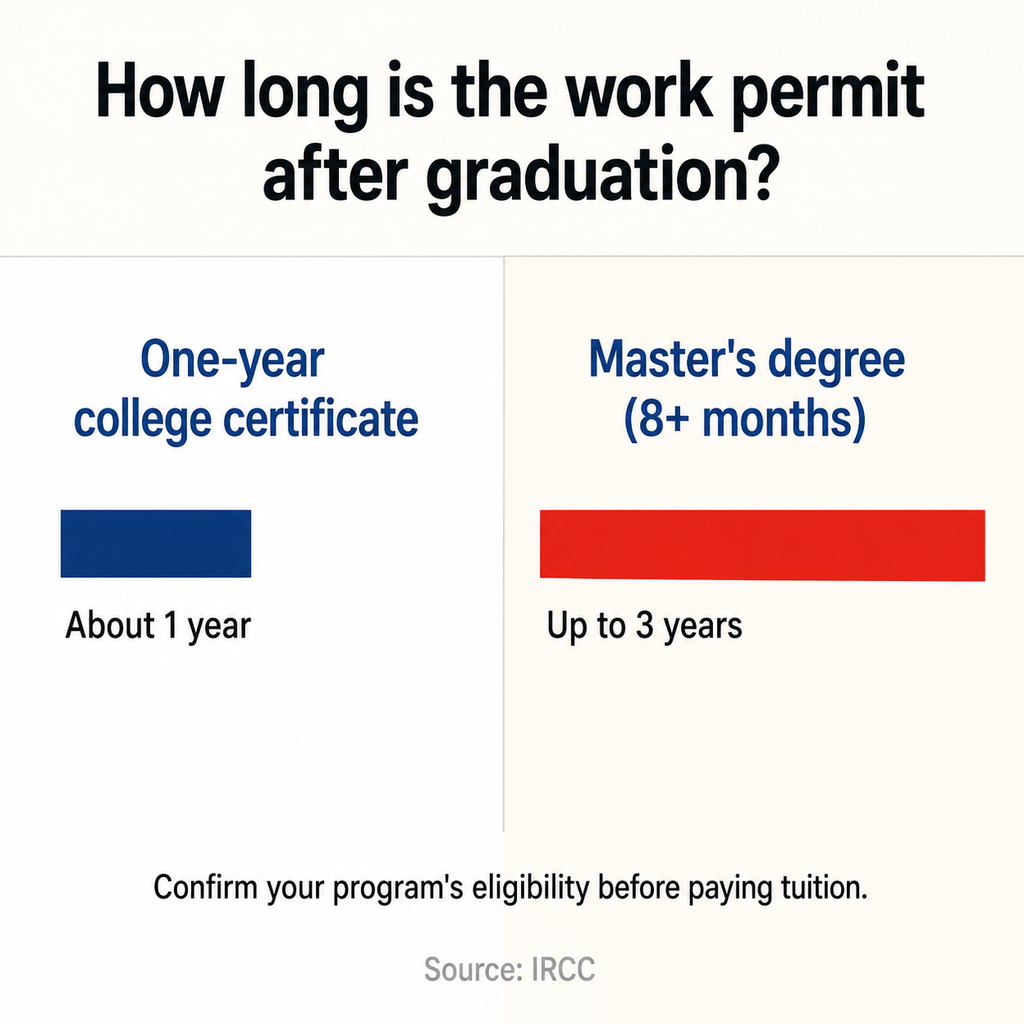
Every step of that pathway is conditional, and one condition trips up the exact student this article is written for. A post-graduation work permit generally matches the length of your program, up to three years. The three-year work permit available to master’s degree graduates does not apply to certificate or diploma programs. A one-year college graduate certificate typically supports roughly a one-year work permit, not three. If post-study work is part of the financial logic of your plan, confirm your specific program’s work permit eligibility and expected duration before paying tuition. Also note that since June 2024, post-graduation work permit applications are online only; the border option does not exist for them at all.
Talk to Us Before You Travel
The Port of Entry option is one of the most genuinely useful tools available to U.S. students, especially those accepted close to their program start date who may not have time for online processing. But it rewards one thing above all, and that is preparation. The rules behind it shifted repeatedly between 2024 and 2026, and some of the current government guidance conflicts with itself.
At Maple Immigration Services, we help U.S. students (and their parents in a lot of cases) figure out whether the border route fits their situation, confirm the current PAL and documentation requirements for their specific program, and build a complete, organized application package before anyone books a flight. We also handle study permit applications end to end for families who want the whole process managed, and we support students planning the longer pathway from study to a post-graduation work permit and beyond. If you are early on in your research, our guide to the top mistakes international students make in Canada is a good next read.
If the border option sounds like it might fit your timeline, tell us about your situation and we will set up a call to give you an honest read on whether your file is ready for it.