
Inland and outland spousal sponsorship both lead to the same result, permanent residence for your spouse or common-law partner. The practical difference is what your partner can do while the application is being processed, and what recourse you have if it is refused. Inland means applying under the Spouse or Common-Law Partner In Canada Class, where the couple lives together in Canada for the whole processing period. Outland means applying under the Family Class, which does not require the applicant to stay in Canada and which carries a right of appeal if the application is refused.
Spousal and partner sponsorship is the area The Maple Team is best known for, and across 15 years of practice we have found this is the decision couples underestimate most, and the one where they have the least understanding of how much the surrounding strategy matters this early in the process. Plenty of sponsors treat it as a box to tick on a form, but in practice the stream you pick shapes the next year or two of your life, and once the application is filed, the stream is set. Here is what separates the two, and the five variables that decide which one fits your situation.
One note first… The rules here, particularly around work permits, have changed several times in the last two years. Everything below reflects Government of Canada policy as of August 2026, and you should confirm current requirements in IRCC’s sponsorship guide before you file.
Inland vs. Outland Spousal Sponsorship: Side by Side
| Factor | Inland | Outland |
|---|---|---|
| Official class name | Spouse or Common-Law Partner In Canada Class | Family Class |
| Who it generally suits | Couples already living together in Canada who plan to stay put | Applicants outside Canada, or in Canada but likely to travel |
| Where the applicant must be | In Canada, cohabiting with the sponsor throughout processing | No location requirement |
| Canadian status required | Valid temporary resident status, or an exemption under public policy | None |
| Travel while the application processes | Risky, because leaving can cancel temporary status and re-entry is not guaranteed | Preserved, since presence in Canada is not a condition |
| Open work permit | May be available once the application is acknowledged | May also be available if the applicant lives in Canada with the sponsor |
| If the application is refused | No appeal to the Immigration Appeal Division | Appeal right to the Immigration Appeal Division, subject to statutory exceptions |
| Conjugal partners | Not permitted in this class | Permitted |
| Published service standard | None | 12 months, which IRCC aims to meet 80% of the time |
What Inland Spousal Sponsorship Means
Inland sponsorship is an application under the Spouse or Common-Law Partner In Canada Class. Under section 124 of the Immigration and Refugee Protection Regulations, a person belongs to that class only if they are the spouse or common-law partner of their sponsor, cohabit with that sponsor in Canada, and hold temporary resident status in Canada. Those are class requirements, not preferences. Under the same regulations, common-law partners also need at least 12 consecutive months of cohabitation to qualify as common-law in the first place.
The appeal of this route is obvious. You stay together while the government works through the file, and your household can start building a life here right away instead of waiting for a decision to arrive.
There is a narrower route for applicants who are in Canada without valid status. A public policy in place since 2005 allows IRCC to process certain in-Canada spousal applications where the applicant has overstayed, worked or studied without authorization, or entered without a required document. It covers a specific list of status problems and nothing beyond them. Being out of status makes an inland file more technical rather than impossible, and it changes when a work permit becomes available.
What Outland Spousal Sponsorship Means
Outland sponsorship is an application under the Family Class. The applicant is not required to be anywhere in particular while it processes, and no Canadian status is needed for the application to be valid.
Two features matter most to the couples we work with. The first is flexibility. If the sponsored partner has a job, a business, aging parents, or a legal obligation outside Canada, the Family Class does not force them to choose between the application and those responsibilities.
The second is what happens if things go wrong. Under section 63(1) of the Immigration and Refugee Protection Act, a sponsor who has filed a Family Class application may appeal a refusal to the Immigration Appeal Division. That right does not exist on the inland side. For couples with a complicated history, a previous refusal, or thin documentary evidence of the relationship, it can be the deciding factor.
Conjugal partner applications can only be made through the Family Class. IRCC’s guide is explicit that someone applying as a conjugal partner cannot be living in Canada. The Family Class also covers other relatives, which is worth knowing if more than one family member may eventually apply.
Outland Does Not Mean Outside Canada
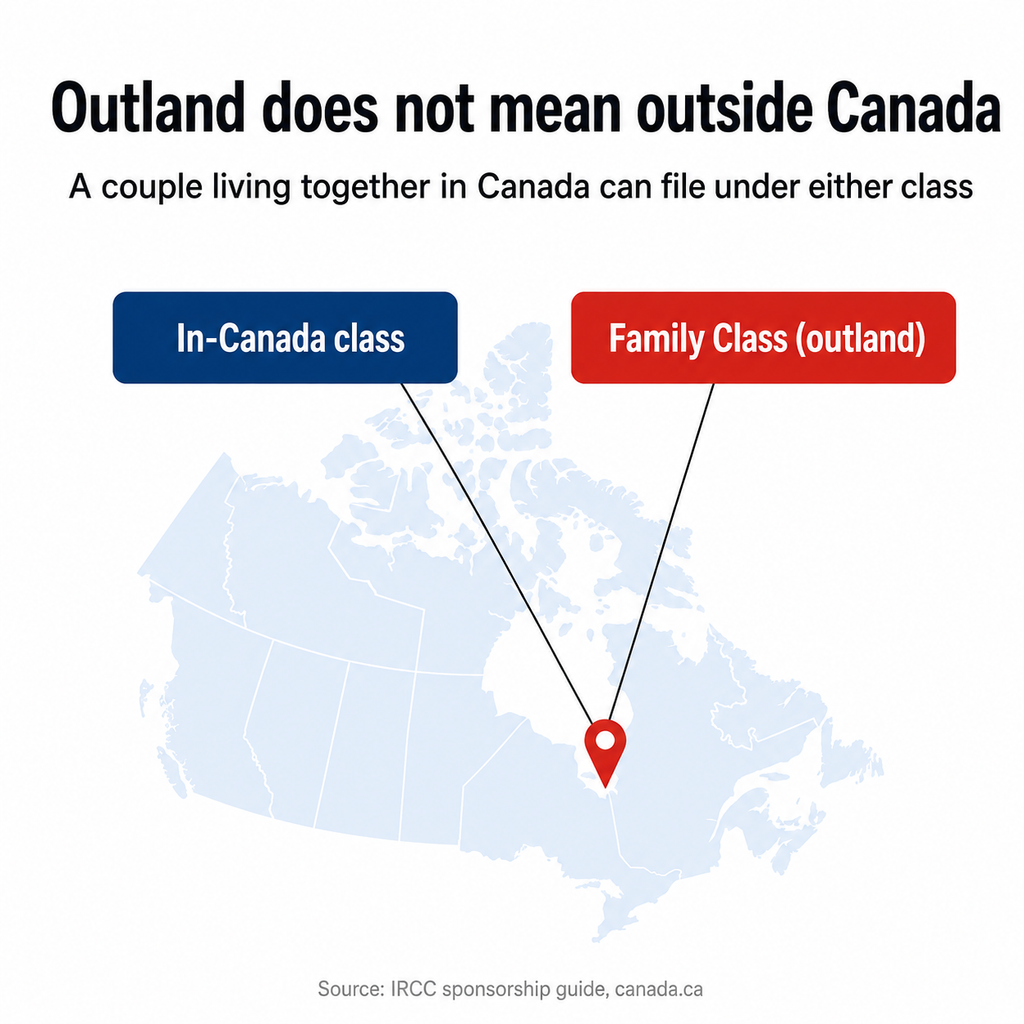
This is the point most articles on this topic get wrong, and it is worth slowing down for.
Inland and outland are two legal classes, not two geographic locations. A couple who are physically together in Canada right now can choose either one. IRCC’s own guide tells sponsors to choose the Family Class where the partner currently lives with them in Canada but does not plan to remain during processing, or where the sponsor wants the option to appeal a refusal.
The work permit rules confirm it. The current open work permit policy for sponsored spouses covers principal applicants who applied under the In Canada Class or under the Family Class, as long as they live at the same address as the sponsor in Canada. A Family Class applicant can be inside Canada, living with their sponsor, and working, for the entire time the application is in process.
“Outland” is a label for which set of rules the application runs under. It says nothing about where your partner has to sit while they wait.
The Five Variables That Decide Which Stream to Use
Most couples arrive at this question asking which stream is faster. Speed is one input, and it is the least predictable one. These five variables are what actually need to be considered.
1. Where the Applicant Can Physically Be
Inland requires the applicant to be in Canada, living with the sponsor, throughout. Outland has no location requirement. If your partner is overseas, or is in Canada now but may need to leave, that points toward the Family Class.
The sponsor’s own location matters too, as a Canadian citizen living abroad may sponsor a spouse or partner if they can show they plan to live in Canada when the sponsored person becomes a permanent resident. A permanent resident sponsor, however, must be living in Canada to sponsor at all. Our page on sponsor obligations sets out what you are committing to.
2. Immigration Status in Canada
Inland needs valid temporary resident status, maintained status, or eligibility under one of the public policies above. For outland, status in Canada is irrelevant to the application.
Being sponsored does not give anyone the right to enter or stay in Canada. If your partner is applying from outside Canada and wants to visit while the application processes, they still have to qualify for a visitor visa or eTA on its own merits. IRCC indicates visitor visa processing can be quicker once the sponsor has an acknowledgement that the PR application is in process, but every usual eligibility requirement still applies.
Holding two intentions at once is legitimate, and having an understanding of Dual Intent is very important. Section 22(2) of the Act confirms that intending to become a permanent resident does not disqualify someone from temporary resident status, provided they would leave at the end of an authorized stay if required. However, and very importantly, Immigration Officers still weigh ties to the home country and what the person would do if the PR application were refused. IRCC’s briefing material on dual intent explains the approach.
3. Whether Your Partner Needs to Work
Work rights are where we spend the most time correcting what people have read.
The old rule of thumb was that inland applicants could work and outland applicants could not. That no longer holds. IRCC’s open work permit route for sponsored spouses sets eligibility as living in Canada, being sponsored for permanent residence, being in a genuine relationship with the sponsor, being included in a PR application, and holding an Acknowledgement Of Receipt (AOR) confirming the application is in process. Eligibility turns on presence in Canada and status rather than the class the application was filed under.
A few details worth knowing:
- The temporary public policy behind this route has been in effect since May 2023. It covers applicants who share a residential address with the sponsor in Canada, whose PR application has been accepted for processing, and who hold valid temporary resident status, have maintained status, or have applied to restore status.
- Permits issued under it can run up to 24 months or until passport expiry, whichever comes first, and can be extended if the PR application is still in process.
- IRCC’s program delivery instruction sets a narrow exception to the AOR requirement. Someone whose work permit, study permit, or temporary resident status expires in two weeks or less may apply without one, provided the spousal PR application has already been submitted.
- If the PR application is processed under the out-of-status public policy and the applicant holds no valid temporary resident status, they must wait for approval in principle before applying for the work permit. Keeping an inland file alive is not the same as being able to work right away.
- The restrictions IRCC introduced in January 2025 and March 2026 tightened open work permits for spouses of workers and students. Those are a separate regime with separate pages and instructions. We read the sponsored-spouse route as unaffected, though no single official page says so directly.
The signed policy behind this route states that it may be revoked at any time, which is a real reason to confirm the current position rather than rely on any article, including this one. Our pages on the spousal open work permit and open work permit eligibility for a spouse go further into the requirements.
4. Whether the Applicant Needs to Travel
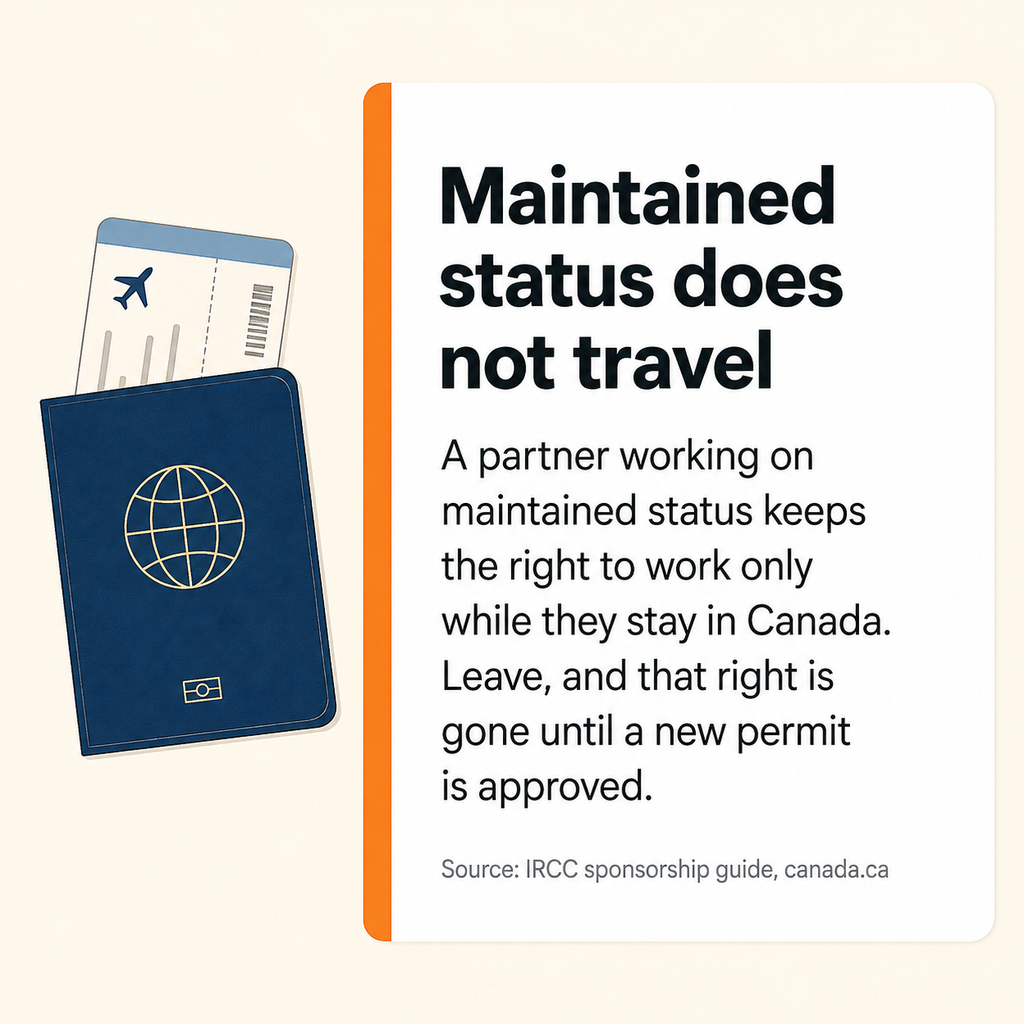
Travel is the variable that quietly does the most damage to inland applications. Nobody is prohibited from leaving Canada, however the real risk is what re-entry carries, and in essence whether you get back in. As professionals we have seen how precarious border entries can become, and how much can turn on the assessment made at the port of entry.
IRCC’s guide warns that leaving Canada can automatically cancel temporary resident status as a visitor, student, or worker, and that a sponsored partner who leaves before becoming a permanent resident “may not be allowed to come back.” If they cannot return, the guide is direct about the consequence: a new overseas sponsorship application has to be submitted.
Three details turn that from a theoretical problem into a practical one:
- A visitor record lets someone stay longer, but it does not guarantee re-entry.
- A work permit is not a travel document and does not guarantee re-entry either.
- A person on maintained status keeps the right to work only while they remain in Canada. If they leave, they may be able to re-enter Canada as a temporary resident if otherwise admissible, but they lose the right to keep working until a new permit application is approved.
That last point surprises almost everyone. A partner working legally on maintained status who takes a two-week trip for a family funeral and comes back as a visitor has impaired their ability to work upon their return.
If there is any realistic chance your partner needs to leave Canada during processing, the Family Class deserves serious consideration.
5. What Happens If the Application Is Refused
Refusals are the part nobody wants to plan for, and the reason the stream choice can matter for years afterward.
On the outland side, section 63(1) gives the sponsor a right of appeal to the Immigration Appeal Division. That appeal is heard fresh. New evidence can be filed, witnesses testify under oath, and the division can allow an appeal for an error of law, an error of fact, or a breach of natural justice. In some family class cases it can grant relief on humanitarian and compassionate grounds. The Immigration and Refugee Board also runs an alternative dispute resolution process that resolves many appeals earlier through a mediation-style discussion.
These are substantial proceedings. The Board reported 3,360 sponsorship appeals filed in 2025 across all family class relationships, with 1,070 allowed and 959 dismissed among those finalized that year, and 1,660 still pending at year end. The Board does not present those figures as a success rate and neither do we. They show a real, contested process with meaningful volume behind it.
The appeal right is not absolute. Section 64 removes it where the refusal rests on inadmissibility for security, human or international rights violations, sanctions, serious criminality, or organized criminality. Misrepresentation-based appeals are also barred, with an exception where the person refused is the sponsor’s spouse, common-law partner, or child.
On the inland side, IRCC’s guidance on what happens after you apply states plainly that where permanent residence is refused under the Spouse or Common-Law Partner In Canada Class, “you can’t appeal.” What remains is judicial review at the Federal Court, which examines the legality and reasonableness of the decision on the record that was in front of the officer. The court does not re-decide the application and generally will not accept new evidence. Where it finds a problem, it sends the matter back to be decided again. Our page on judicial review explains the mechanics of this process in greater detail.
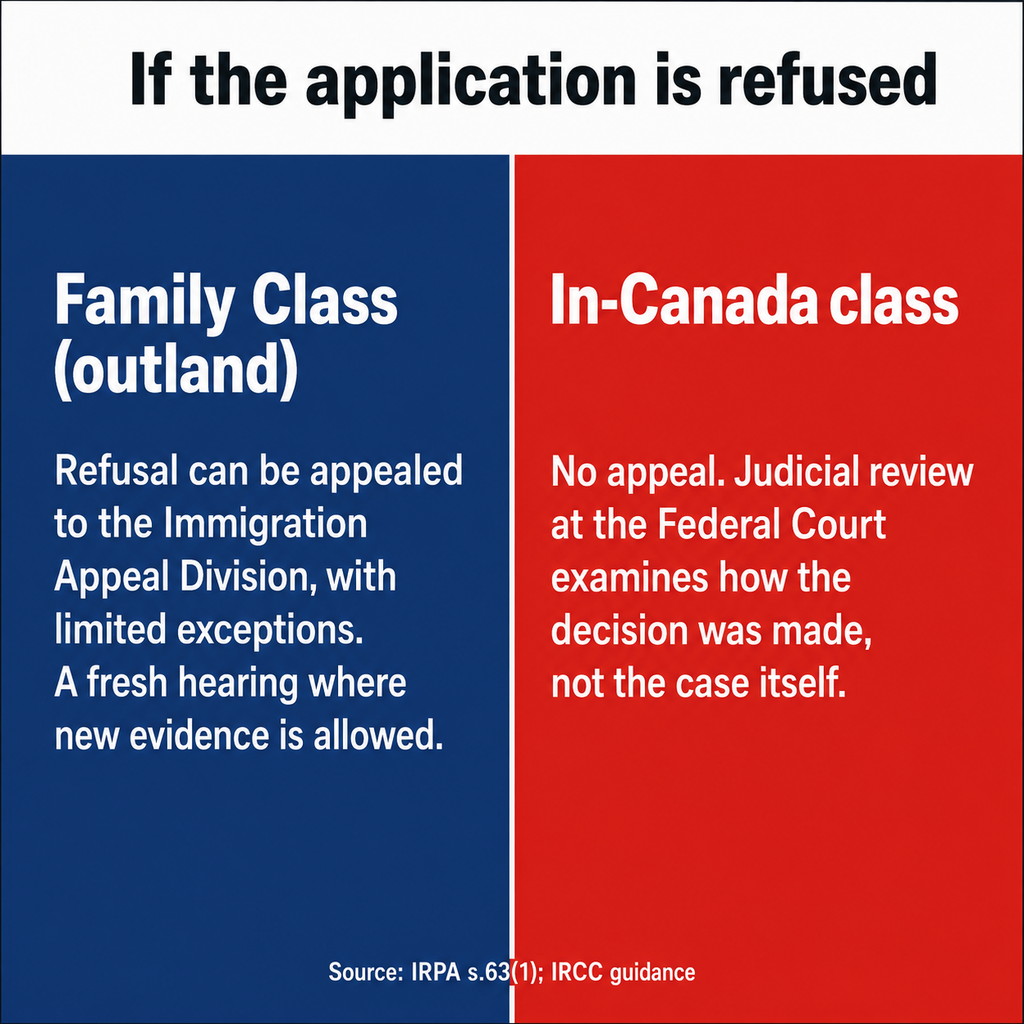
The practical difference comes down to evidence. An appeal is a chance to fix a gap in your case. A judicial review is a challenge to how the decision was made. Reapplying with a stronger package is also common in practice, though IRCC does not present it as a formal remedy.
If a refusal is already on the table, or you are weighing a case where credibility could be an issue, we can assess what recourse you actually have and connect you with the right representation. That assessment is often the most useful thing we do at this stage.
Which Spousal Sponsorship Stream Is Faster?
There is no stable answer, and that itself is worth knowing before you plan around a timeline.
There is a published service standard for the overseas Family Class stream of 12 months, which IRCC aims to meet 80% of the time. There is no published service standard for the in-Canada class at all. IRCC manages the two streams differently, and that missing standard is one of the clearer signs of it.
The actual figures have moved in both directions. A departmental note from August 2024 put overseas spousal processing at about 12 months and in-Canada at about 8 months, on figures current to that July. By the first half of 2025, the ministerial transition binder reported wait times for new applicants of 12 months overseas and 24 months in-Canada. Within about a year of official data, the faster stream became the slower one. IRCC’s most recent published figure does not separate the two streams at all: for June 2025 to May 2026 the department reports processing spousal and partner applications filed inside and outside Canada, for destinations outside Quebec, in about 14 months. Any article that tells you one stream is reliably quicker is describing a snapshot rather than a rule.
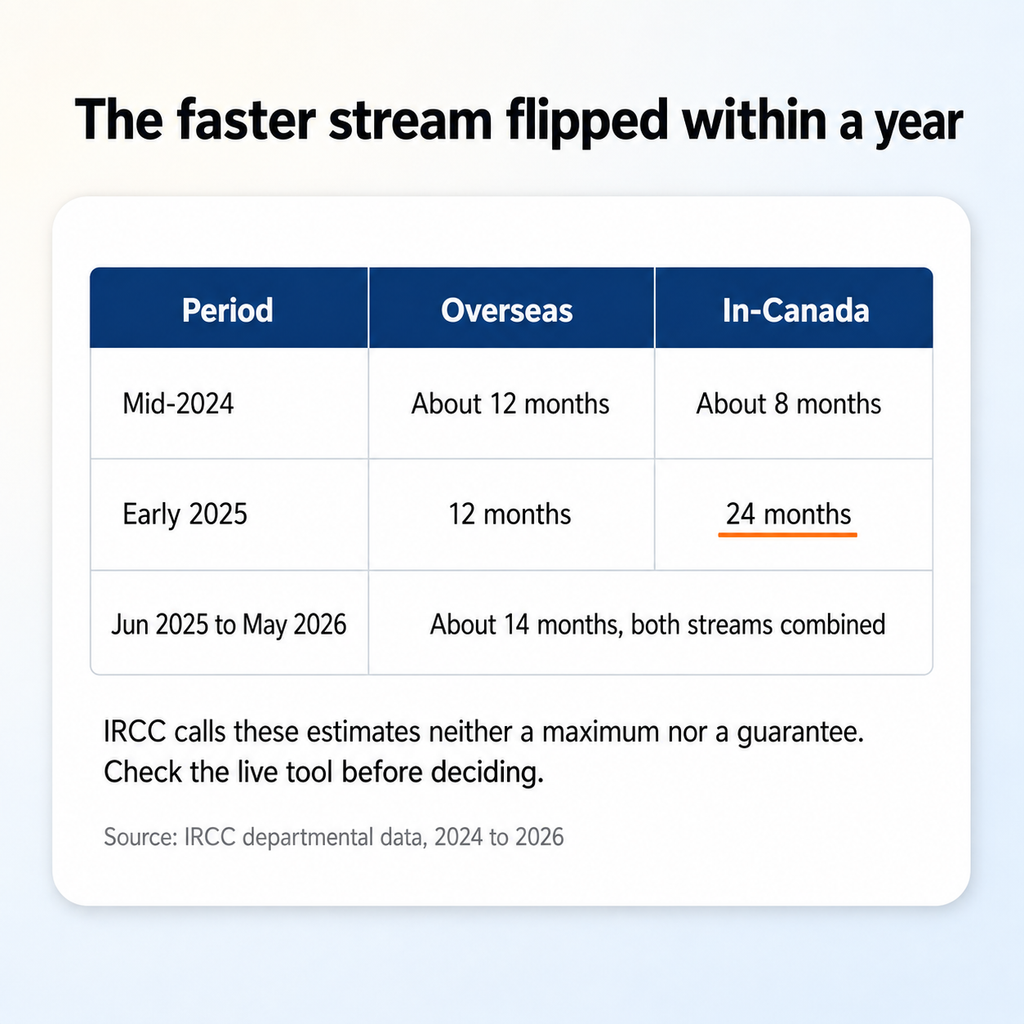
IRCC’s own caveat is worth taking at face value. The department says its estimates are updated regularly and are “not a maximum or a guarantee.” Check the live processing times tool on the day you are deciding, and treat the result as an estimate for a category rather than a forecast for your file. Our article on the timeline and processing steps for spouse immigration walks through each stage.
Brandon Miller, the Regulated Canadian Immigration Consultant who leads our practice, reads the pattern this way: family reunification is one of the objectives written into the Immigration and Refugee Protection Act, and where a couple is presumed to be separated by a border, attention tends to follow. That is his interpretation as a practitioner rather than documented policy. What the department’s own material does confirm is that the streams are operationally managed in different ways. The same departmental note records that IRCC expanded automated processing tools to overseas spousal files in May 2024, having already used automated tools on in-Canada files.
How Quebec Changes the Decision
If the sponsor lives in Quebec, a second layer cuts across both streams and is often more consequential than the inland or outland choice.
Sponsors in Quebec must complete a separate undertaking with the province’s immigration ministry after IRCC approves them as a sponsor. If that undertaking cannot be submitted right away, the permanent residence application stays in IRCC’s inventory and cannot be approved until Quebec issues it.
Quebec also has caps on its intake. The province opened a reception period running from 2 July 2026 to 30 June 2028, with a limit of 13,300 undertaking applications for spouses, common-law partners, and conjugal partners. IRCC’s briefing to the minister attributes the longer Quebec waits to the department receiving more family class applications than Quebec’s admission targets accommodate, which has built a backlog.
What Is the Same in Both Streams
Several things people expect to differ do not, which takes some noise out of the decision.
- Government fees. The fee structure does not differ between the streams. Current amounts are on IRCC’s fee list and they do change, so check them on the day you file.
- Medical exams. The sponsored person needs one, and family members must complete one even if they are not coming to Canada. The requirement is the same in both streams.
- Police certificates. IRCC’s sponsorship guide requires them for the applicant and family members aged 18 and over, for any country other than Canada where they lived six months or more in a row since turning 18. For spousal sponsorship they are submitted with the application package.
- Biometrics. Requested for the sponsored person and due within 30 days of the request letter. In-Canada applicants can attend a Service Canada location.
- Interviews. Possible in either stream. We have not seen an official source that quantifies how likely an interview is in one stream versus the other, so treat it as a possibility to prepare for rather than a reason to pick a side.
Can You Switch Streams After Filing?
Practically speaking, no. IRCC’s guidance does not provide a mechanism to convert an in-Canada spousal application into a Family Class application. The route available is withdrawing and filing again.
Withdrawal has its own conditions. IRCC’s guide requires a written request before a final decision is made on the file, and the withdrawal only takes effect if IRCC approves it. Where a sponsor is found ineligible, most fees are refunded, though the sponsorship fee is not, and no decision is made on the permanent residence application. In practical terms, changing your mind means losing your place in the queue and starting over.
This is why we push hard on getting the decision right before anything is submitted. As Brandon puts it: “This is not just about getting the application submitted. It is about choosing the right strategy before the application goes in as there are so many variables that need to be taken into account upfront and adapted to during the process.“
How to Decide Which Stream Fits Your Situation
The right stream depends on your facts. Working through it in this order tends to make the answer clear.
- Where will your partner actually be for the next 18 months? If the honest answer includes travel outside Canada, weigh the Family Class heavily.
- What is your partner’s status in Canada right now? Valid temporary resident status opens the inland route. No status means either the out-of-status public policy, with its narrower work permit timing, or the Family Class.
- Does your partner need to be earning? Both routes can lead to an open work permit if they are living in Canada with you. Being out of status changes when that becomes possible.
- How strong is the documentary evidence of your relationship? A previous refusal, a short relationship history, or a gap in the paper trail all make the appeal right on the Family Class side worth a great deal.
- Is separation tolerable? For many couples this decides it, and it deserves to be treated as a real factor rather than a soft preference.
For some families, staying together in Canada is the priority. For others, preserving travel flexibility or appeal rights matters more. Both are reasonable answers, and they lead to different filings.
There is a second layer we look for at this stage, the small issues that are easy to overlook and hard to fix later. Brandon calls them the “by the ways“: an old refusal in another country, a gap in status nobody mentioned, a job offer starting in six weeks, a parent who is unwell overseas. They surface in planning conversations, and they routinely change the recommendation.
Common Questions About Inland and Outland Spousal Sponsorship
Can my spouse work while we wait for permanent residence?
Possibly, in either stream. A sponsored spouse living in Canada with their sponsor may be eligible for an open work permit once the permanent residence application has been acknowledged as in process, whether it was filed under the In Canada Class or the Family Class. If they are in Canada without valid status under the out-of-status public policy, they have to wait for approval in principle first.
Can my spouse visit Canada while an outland application is being processed?
Yes, if they qualify for temporary entry on their own. Being sponsored does not create a right to enter Canada. Your partner still needs a visitor visa or eTA and still has to satisfy an officer that they meet the requirements, including that they would leave if required.
Can we change from inland to outland after we file?
There is no conversion process. The available route is to withdraw the application, with IRCC’s approval and before a final decision, then file again under the other class. That costs time and the sponsorship fee, which is why the choice should be made deliberately at the start.
Does my spouse’s time in Canada on a temporary permit count toward citizenship?
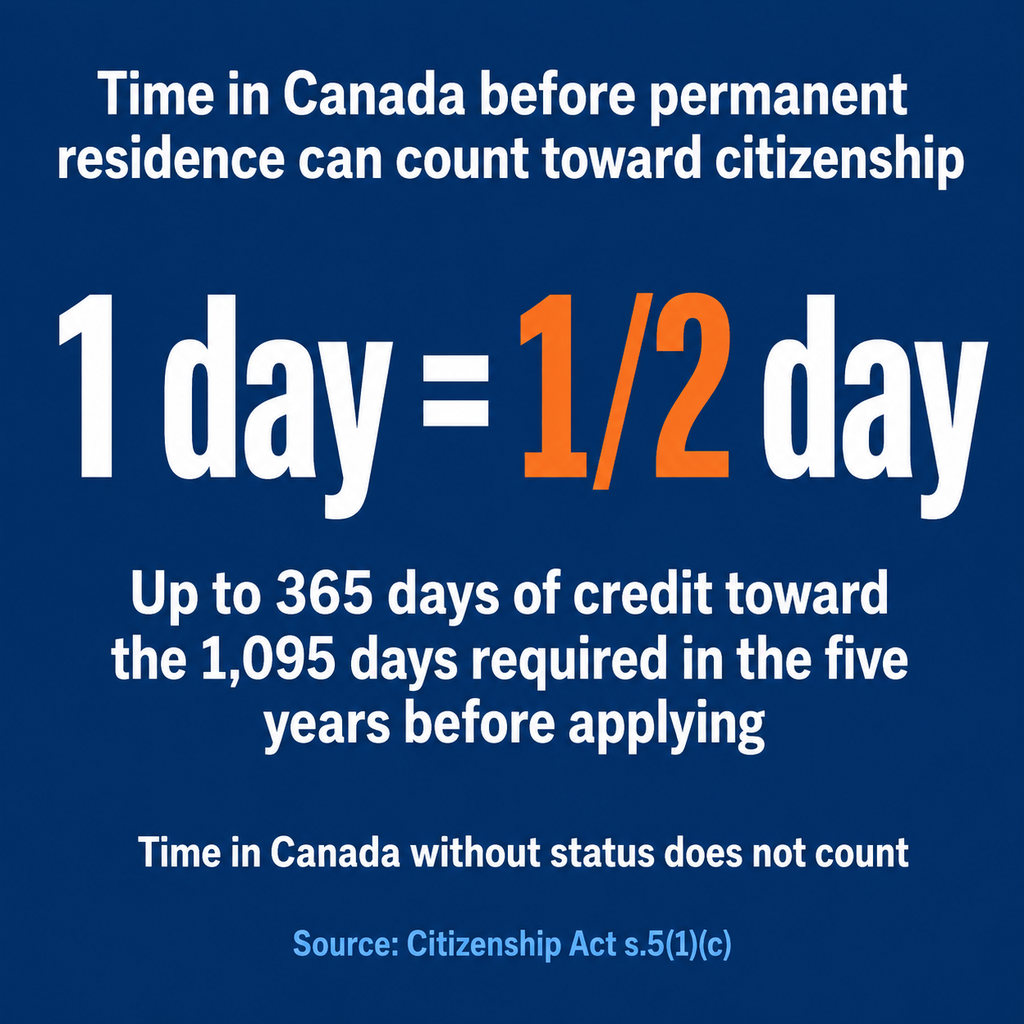
Partly. Each day physically present in Canada as a temporary resident before becoming a permanent resident counts as half a day toward the citizenship physical presence requirement, up to a maximum credit of 365 days, against a requirement of 1,095 days in the previous five years. Time in Canada without status does not count. Our Canadian citizenship page covers the requirement in full.
Is inland sponsorship available to conjugal partners?
No. A conjugal partner application has to be made under the Family Class, and IRCC’s guide states that a person applying in the conjugal partner class cannot be living in Canada.
Talk It Through Before You File
Every immigration application has two parts, the planning and the execution, and this is a category where the planning carries most of the weight. The stream choice is made once, before anything is submitted, and it follows you through the whole process. There are many key strategies that have to be weighed out along the way, but this is one decision that must be understood and planned for from the outset.
If you are at that point, we would rather have the conversation now than untangle it later. Tell us about your situation and we will set up a discovery call to go through it in detail, whether you want us to handle the whole application, want guidance at set intervals while you do the work yourself, or just want to understand your options before committing to anything. Bring the awkward details. Those are usually the ones that decide it.