By The Maple Team

If you have a Canadian great-grandparent, you may have a claim to Canadian citizenship that’s worth checking, as since December 15, 2025, Canadian citizenship can pass down through more than one generation born outside Canada. You may already be a citizen if you were born before that date and each generation between you and your great-grandparent was born to a parent who was (or became) a Canadian citizen. Whether you are able to stake your claim to Canadian citizenship depends on your family’s history and the records that prove it.
At Maple Immigration Services, we help people check whether they have a claim and apply for proof of citizenship, and working with U.S. applicants is one of our focus areas.
What changed with Bill C-3?
Bill C-3 removed the first-generation limit, the rule that generally stopped citizenship by descent after the first generation born outside Canada. Under that rule, a Canadian who moved abroad could pass citizenship to their children born abroad, but those children generally could not pass it on to their own children born abroad.
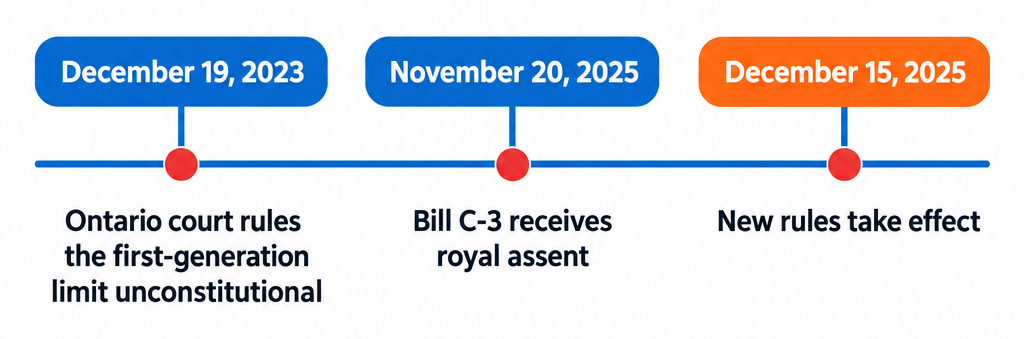
On December 19, 2023, the Ontario Superior Court of Justice ruled that the main parts of the first-generation limit were unconstitutional. Parliament responded with Bill C-3, An Act to amend the Citizenship Act (2025), which received royal assent (the final approval that makes a bill law) on November 20, 2025. The date that matters for you is when the new rules took effect, which was December 15, 2025.
The change affects fewer people than some headlines suggest. Immigration, Refugees and Citizenship Canada (IRCC), the federal department that handles citizenship, expects “tens of thousands (and not hundreds of thousands)” of people to be affected. The Parliamentary Budget Officer gave a separate, higher estimate of around 115,000. IRCC has said estimates like these are uncertain, in the same notes to a Senate committee that report both figures.
How does citizenship pass down from a great-grandparent?
Canadian citizenship passes down one parent-to-child link at a time, so a great-grandparent’s citizenship reaches you only if each person between you and that ancestor was a Canadian citizen as well.
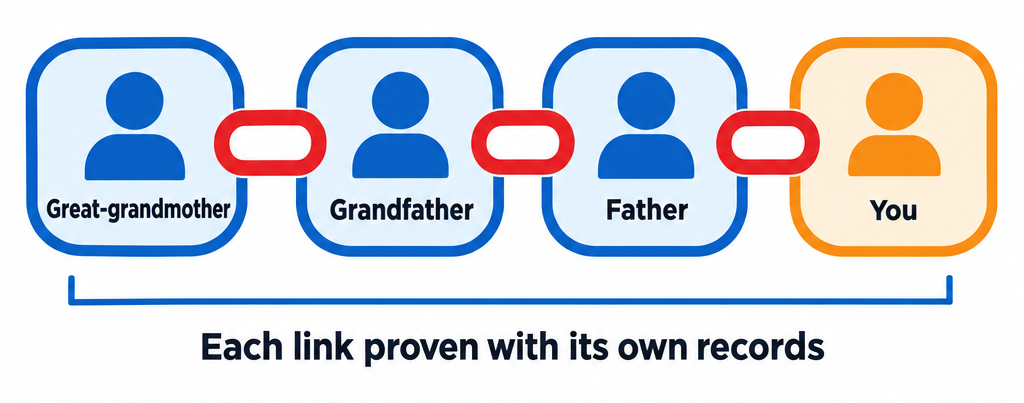
Imagine your great-grandmother was born in Nova Scotia in the 1890s and later moved to Massachusetts, where your grandfather was born. Your father was born in the U.S. too, and so were you. To show that citizenship passed all the way down to you, the claim would need to establish each of these points:
- Your great-grandmother was a Canadian citizen. Proving that starts with the earliest record that shows her birth, such as a baptismal record or a census entry. Because Canadian citizenship didn’t exist until 1947, the claim also has to show her status on January 1, 1947, which the next section explains.
- Your grandfather was her child, usually shown with his birth record naming her as his mother.
- Your father was your grandfather’s child.
- You are your father’s child.
Each link has to be proven on its own, with its own records, so if a link can’t be proven, the people after it can’t claim citizenship through that line, even when every other link is documented. Where a name changes along the way, for example through marriage, you also need the records that connect the old name to the new one. A great-great-grandparent or an ancestor further back works the same way, with more links to prove.
Whether a claim works depends on the facts of your own family, so a story online about someone else’s great-grandparent isn’t a guide to yours. One family’s line might include an ancestor who became a citizen of another country before 1947 (the next section explains why that can matter), or a generation whose birth record can’t be found, and details like these can change the answer.
If your Canadian connection is a parent instead of an ancestor further back, our page on Canadian citizenship by descent covers that more direct situation.
Does it matter if my ancestor lived before 1947?
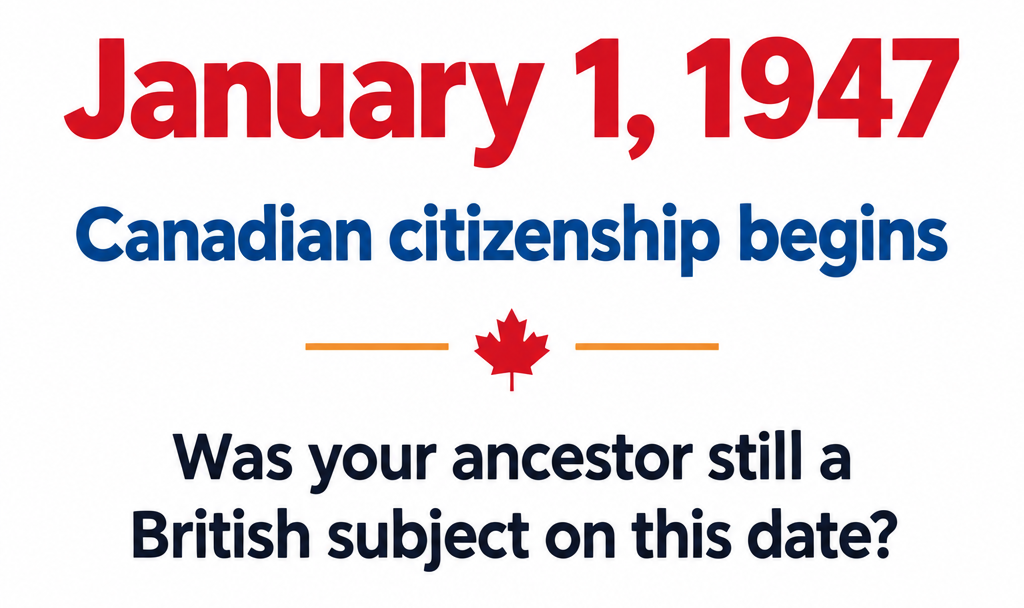
When your ancestor lived can matter, but an ancestor born before 1947 isn’t automatically ruled out. Canadian citizenship as a legal status only began on January 1, 1947 (April 1, 1949, in Newfoundland and Labrador). Before then, people in Canada held British subject status, so a great-grandparent born in Canada in the 1890s was a British subject at birth.
What matters is whether your ancestor still held British subject status on January 1, 1947, when the law creating Canadian citizenship took effect. IRCC’s guidance for its officers explains that a person born before 1947 had to still be a British subject on that date to become a Canadian citizen, and someone who had already lost that status did not become a citizen then.
One way an ancestor may have lost British subject status is by becoming a citizen of another country before 1947, although IRCC’s applicant pages don’t set out the rules for this. In the example above, one question would be whether your great-grandmother became a U.S. citizen after moving to Massachusetts, and if so, when. In a case like this, we check the answer against her records, such as any naturalization papers, with the help of the genealogists we work with.
Born before or after December 15, 2025: what’s the difference?
The main difference is an extra test that applies only to children born outside Canada on or after December 15, 2025.
| Topic | Born outside Canada before December 15, 2025 | Born outside Canada on or after December 15, 2025 |
|---|---|---|
| Where things stand | According to IRCC, in most cases a person born to a Canadian parent is automatically a citizen, including beyond the first generation | A citizen only if the Canadian parent meets the test below |
| The extra requirement | None beyond proving each generation | Currently, the parent (also born abroad) must have spent at least 1,095 days (about three years) in Canada before the birth |
| Next step | Apply for a citizenship certificate, the document that proves Canadian citizenship | Apply for the child’s certificate, with proof of the parent’s days in Canada and of each generation |
If you were born before December 15, 2025, a citizenship certificate confirms a citizenship you may already have. That’s separate from immigrating: you don’t apply for permanent residence or move to Canada to get one.
The right-hand column matters for any children you’ve had since the law changed, or plan to have, because you would be the parent whose days in Canada count. The 1,095 days are currently counted as a total, so they don’t need to be consecutive.
How do I prove Canadian citizenship through a great-grandparent?
You prove Canadian citizenship through a great-grandparent by applying to IRCC for a citizenship certificate. As IRCC currently describes the process:
- The fee is $75 per person.
- You must submit a paper application if you were born outside Canada to a Canadian parent who was also born outside Canada. In a great-grandparent claim, you and your parent were usually both born abroad, so this usually applies to you.
- Once you have the certificate, you can use it to apply for a Canadian passport, since the certificate itself isn’t a travel document.
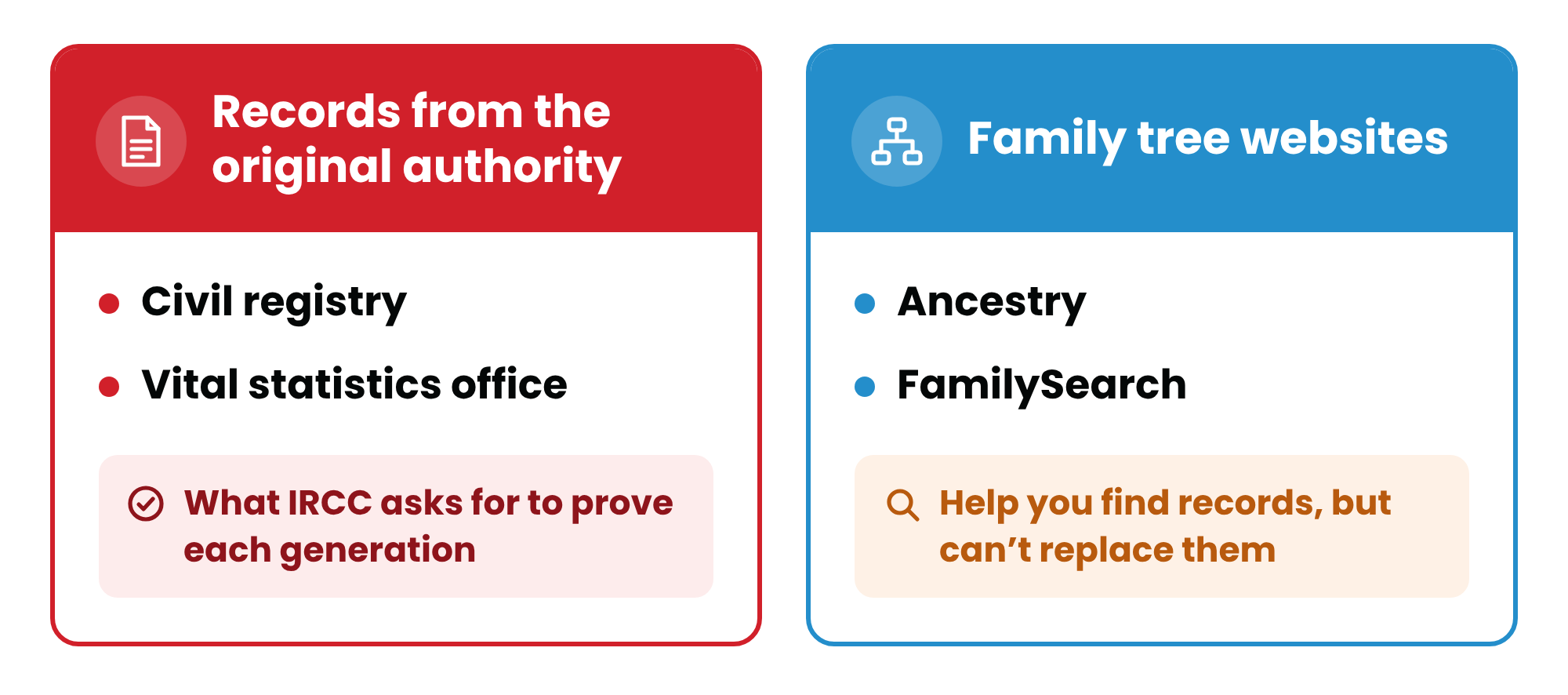
What matters most in the application is the evidence for each generation. IRCC asks for documents from the original authority, meaning the office that created or keeps the record, such as a civil registry or vital statistics office. It also states that “your application can’t be supported solely by third party records,” so family trees on Ancestry or FamilySearch can help you find the records you need but can’t take their place.
A multi-generation file generally starts with records like these:
- A birth certificate for each generation that names the parents, whether it’s a Canadian provincial or territorial certificate or a foreign one.
- A citizenship or naturalization certificate, where someone in the line had one.
- Other records when a birth certificate doesn’t exist, such as a hospital birth record, a record from the physician or midwife present at the birth, a baptismal record made reasonably soon after the birth, a census record or a boat manifest.
- A written explanation when an official document can’t be found at all, along with proof that you tried to get it, such as the replies from the offices you asked.
- Translations of any document that isn’t in English or French, done by a translator who provides a sworn statement. IRCC doesn’t accept translations done by the applicant or their family members.
- Two pieces of identification (one with a photo) and, for the paper application, two identical printed citizenship photos.
Treat this list as a starting point, not a complete checklist. A file usually needs at least these records and often more, depending on the family’s history, such as records connecting a maiden name to a married name or extra records that stand in for a missing birth certificate.
Missing records are one of the most common worries, and they don’t always end a claim. Genealogists at the Niagara Peninsula Branch of Ontario Ancestors make a useful point about this: “Sometimes the best evidence is not a single perfect document but a cluster of records.” A baptism, a census entry and a marriage record can together show a link that no single birth certificate does.
IRCC doesn’t promise how long a certificate will take, so for a current estimate, check IRCC’s processing times tool. Your own application may take more or less time depending on how complete it is and how easily IRCC can verify the information.
Why get the application right before you submit it?
Getting the application right before you submit it matters because a weak application can cost you time, possibly years. In our experience, most people who come to us have already gathered some records, which is a good start, but those records are rarely at the standard a successful application needs. A record can fall short in simple ways, for example when it’s a family-tree printout instead of a copy from the office that issued it.
An application with missing links is unlikely to succeed, and weak applications add to IRCC’s backlog. If yours comes back, you have to gather what was missing and apply again, and that is where the lost time comes from.
That’s why, before anything goes to IRCC, we work out which records prove each link and where the gaps are. For multi-generation cases, we work with vetted genealogists who are experts in establishing the required links to IRCC standards. They do the archival research, tracking down historical records and ordering copies from the offices that hold them. Our role is to assess the claim, build the application, submit it and represent you through the process, which you can read more about on our Canadian citizenship page.
If you have a Canadian great-grandparent and want to know whether your family’s line holds up, tell us about your situation and we’ll set up a call to walk through it with you. You don’t need every record in hand before we talk, and a conversation about what you already have is the best place to start.