
The first step in choosing an immigration consultant in Canada is verifying their licence, before you look at anything else. Only three types of professionals can legally charge for Canadian immigration advice or represent a client: Regulated Canadian Immigration Consultants (RCICs) licensed by the College of Immigration and Citizenship Consultants (CICC), lawyers and paralegals in good standing with a provincial or territorial law society, and Quebec notaries. It is worth noting that paralegals are restricted to tribunal work only, unless they also obtain a licence with the CICC.
Anyone else offering paid immigration help is committing an offence (even a lawyer who is not registered in Canada), and if they mishandle your application, you’re the one who lives with the consequences. Once the licence checks out, the decision comes down to experience with your type of case, transparency about fees and agreements, and whether they tell you the truth about your chances.
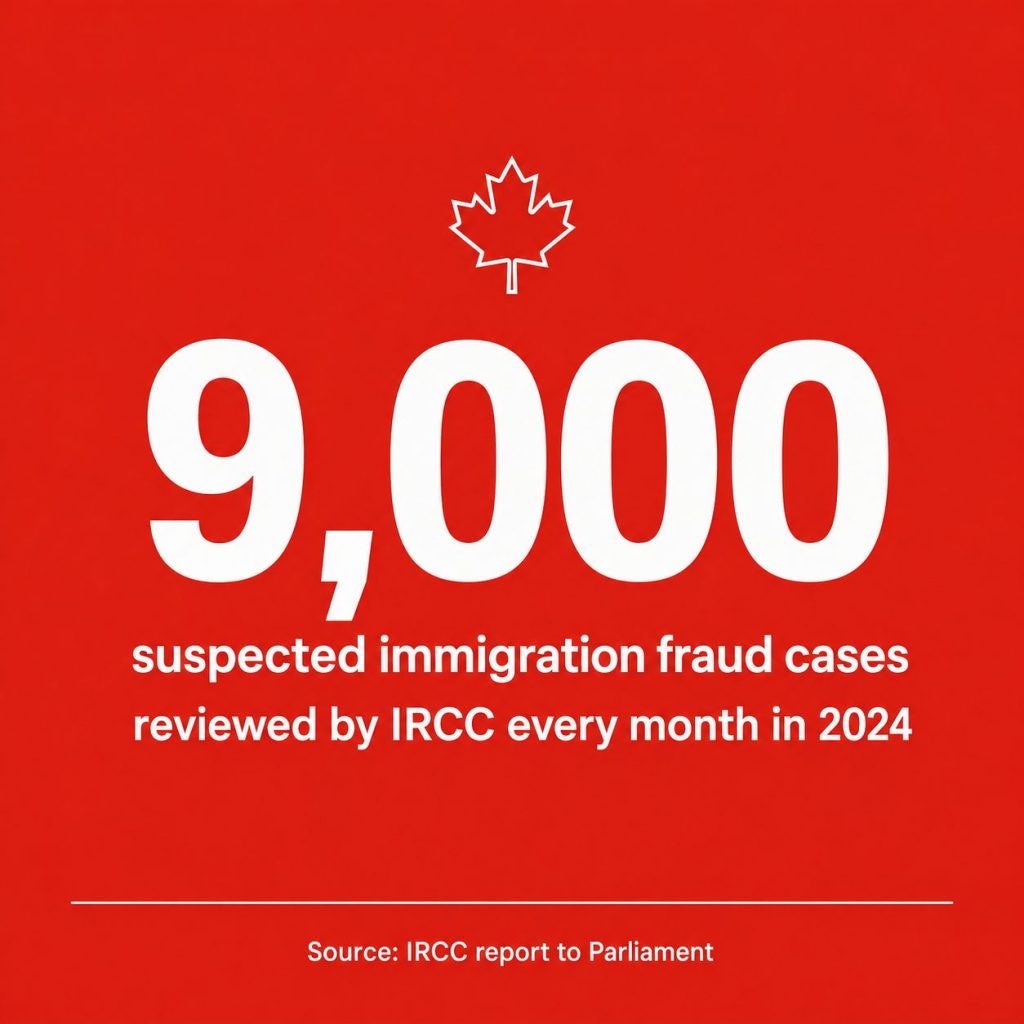
The scale of the problem is bigger than most people expect. IRCC told Parliament that in 2024 it reviewed an average of roughly 9,000 suspected immigration fraud cases every month. Most people hiring immigration help are doing it for the first time, and have years of their lives riding on the outcome. In some cases it is a life changing situation for them and for the generations that follow. That is why vetting the person you hire is the single most practical protection you have.
At Maple Immigration Services, we sit on the inside of the profession, and this guide teaches you what you need to know to vet anyone in it, including us. Our founder, Brandon Miller, is a Regulated Canadian Immigration Consultant with 15 years in practice. He has taught the immigration consultant program at Herzing College in Toronto and serves on the national advisory committee for the Queen’s University graduate diploma, the only English language program in Canada for people training to become RCICs. His licence number is R507745, and we’d rather you look it up than take our word for it. This guide shows you exactly how to do that.
Who Can Legally Charge for Immigration Advice in Canada?
Paid immigration advice is a regulated activity in Canada. Under section 91 of the Immigration and Refugee Protection Act, charging for immigration advice or representation without authorization is a criminal offence, punishable by fines of up to $200,000 and up to two years in prison.
Three types of professionals are authorized to charge for this work:
| Representative type | Who regulates them | Where to verify them |
|---|---|---|
| Regulated Canadian Immigration Consultant (RCIC) | College of Immigration and Citizenship Consultants (CICC) | CICC Public Register |
| Lawyer, or paralegal in Ontario | Provincial or territorial law society | Law society directories, such as the Law Society of Ontario directory |
| Quebec notary | Chambre des notaires du Québec | Chambre des notaires directory |
Two details worth knowing before you go further:
- If your paid representative is not in good standing with the relevant regulator, IRCC can return your application. The government checks, so you should too.
- A related credential, the Regulated International Student Immigration Advisor (RISIA), is worth mentioning as well. It is a real CICC licence, but with a narrow scope. RISIAs work within schools and can advise on study permits, but they cannot represent you or complete immigration forms on your behalf. If you’re hiring help for sponsorship, permanent residence, or anything beyond student advising, a RISIA licence is not the credential for the job.
How Do I Verify an Immigration Consultant’s Licence?
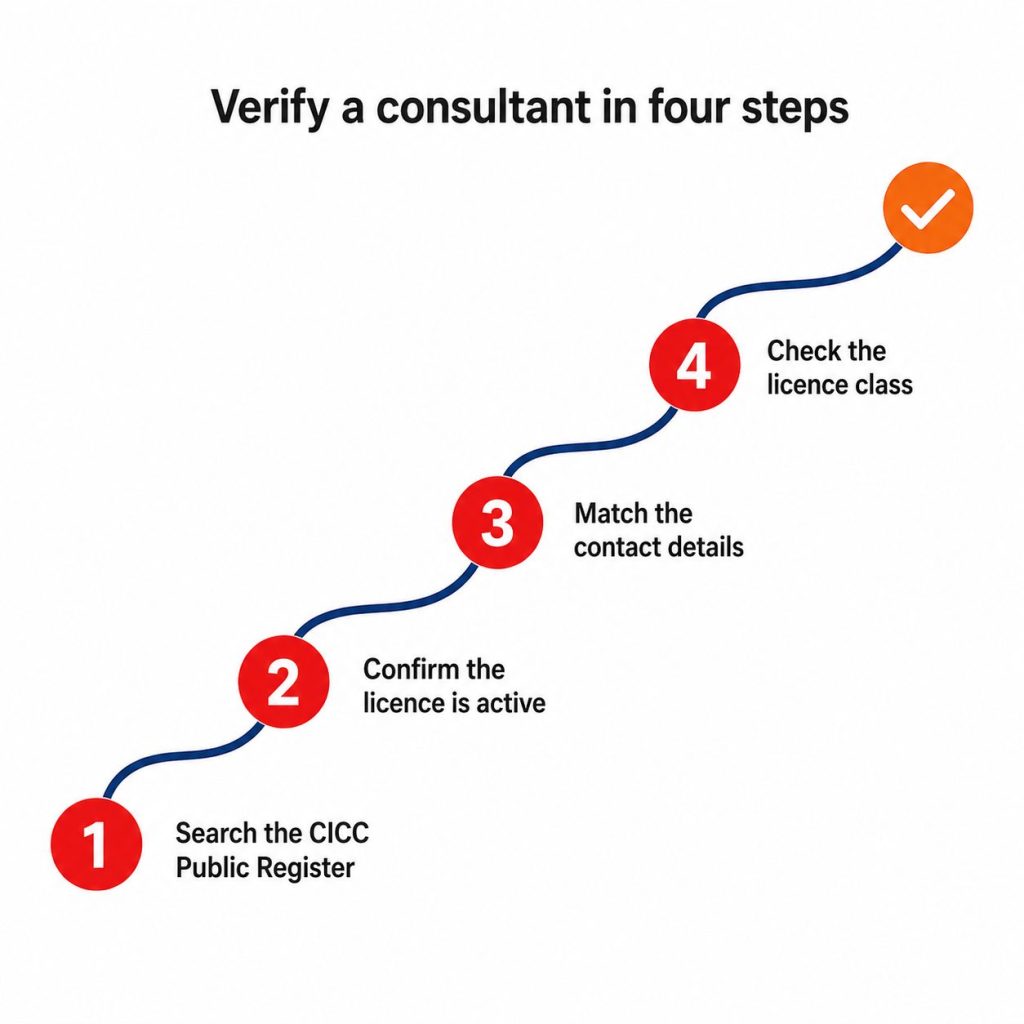
You can verify any immigration consultant in Canada in a few minutes, for free, on the CICC Public Register, linked in the table above. Here’s the full check:
- Search the register by the consultant’s name, company name, or College ID number.
- Open their profile and confirm the licence status is active. The profile also shows licence history and any discipline history, including suspensions, revocations, and current proceedings.
- Match the contact details. Compare the phone number, email, and company name on the register against the ones you were given. Impostors borrow the names and licence numbers of real consultants, so a register listing alone is not enough. The details have to match the person actually talking to you.
- Check the licence class if your case involves a hearing. Since July 2023, representing clients before the Immigration and Refugee Board requires a specialized RCIC-IRB licence. The register shows each licensee’s entitlement to practise, so you can confirm the person is licensed for your kind of matter, not just licensed in general.
As a worked example, run the number R507745 through the register. You should find Brandon Miller at Maple Immigration Services in Toronto. That’s the entire test, and it’s the same one we’d want you to apply to anyone in our profession.
Lastly, and importantly, one naming detail trips people up. The regulator changed in November 2021, when the CICC replaced the former CICC, and every legitimate consultant has been licensed by the CICC since then. If someone is still marketing themselves as an “CICC member” in 2026, their branding is years out of date at best. At worst, it’s a sign they were never licensed at all.
What Is a Ghost Consultant?
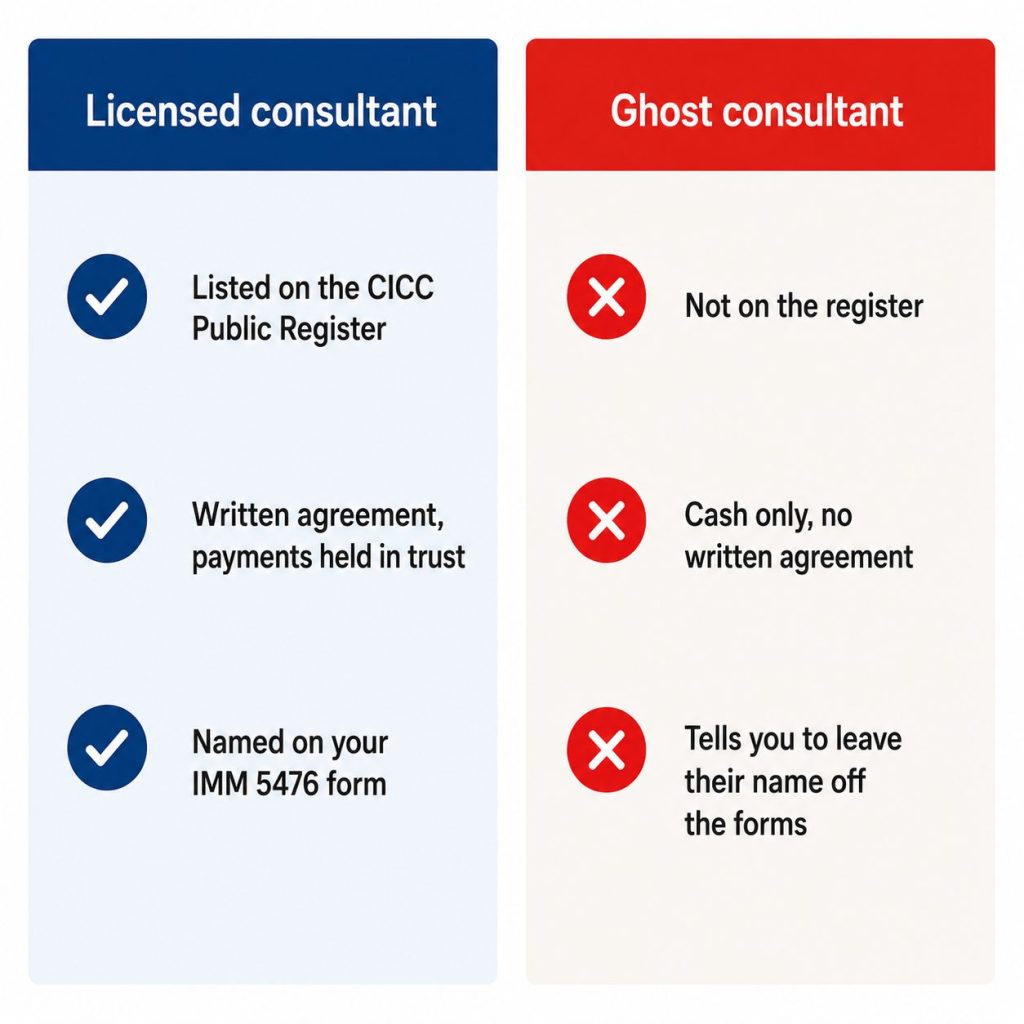
A ghost consultant is an unlicensed person who charges for Canadian immigration advice or representation. The official term is unauthorized practitioner (UAP), and by definition they do not appear on the CICC Public Register. Many operate from outside Canada, advertise heavily on social media, and tell clients to leave their name off the application forms so the file looks self-prepared.
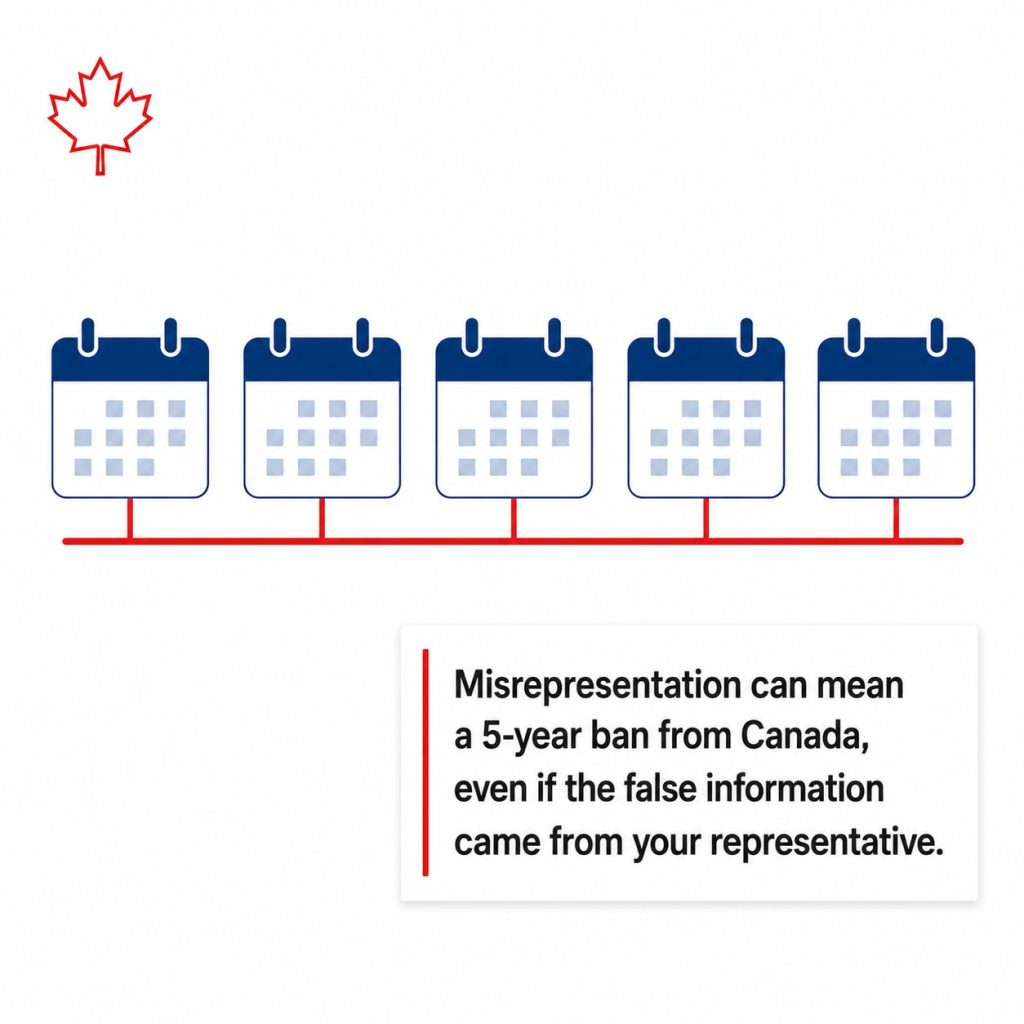
The trap is that the consequences land on you, not them. Your application carries your signature, and under Canadian law, misrepresentation on an immigration application can make you inadmissible to Canada for five years, on top of refusal, loss of status, or removal. Federal Court decisions have upheld five-year bans even where the false information came from the representative and the applicant didn’t know about it. Hiring the wrong person can cost you half a decade, and in many cases it reaches beyond Canada. Countries increasingly share immigration data, and most applications require you to disclose previous refusals, so a finding against you here can follow you into other systems.
In 2024, an unlicensed operator was convicted of unauthorized immigration representation in an Edmonton courtroom after charging two clients $30,000 and $45,000 for jobs that did not exist, and was ordered to pay $148,000 in restitution. The College also reported shutting down more than 5,000 websites and social media pages run by unauthorized practitioners in a single year.
This one is personal for us. Brandon found his way into the profession through a ghost consultant, though not as a client. Years ago, an education contract connected him to a company that turned out to be the occupational arm of a large unlicensed immigration operation. At the time he questioned whether the way they were operating was legitimate, and once he looked into it he learned very quickly that it was in fact an illegal operation under Canadian law. It has stayed with him ever since. An organization run from overseas can look completely legitimate and still be breaking Canadian law.
If you come across someone you suspect is practising without a licence, you can report it to IRCC or call the CBSA Border Watch Line at 1-888-502-9060.
How to Vet an Immigration Consultant Beyond the Licence
A valid licence is the floor, not the ceiling, and it is only the beginning of how you should evaluate someone you are, in effect, handing your future to. Here’s what separates a consultant you can trust and who has the competence to do the work from one who merely passed the exam.
Look for experience with your type of case
Immigration is a wide field, and most consultants develop depth in particular programs. Ask directly: how much of your practice is cases like mine? A consultant who handles spousal sponsorship every week will know the evidence that satisfies a genuineness review. One who mostly files study permits may not. In our own practice, spousal and family sponsorship is the area we’re best known for, and we say so openly because that’s exactly the kind of answer you should expect from anyone you interview. You can read more about how we work as a reference point for the questions worth asking.
Check their discipline history and reviews
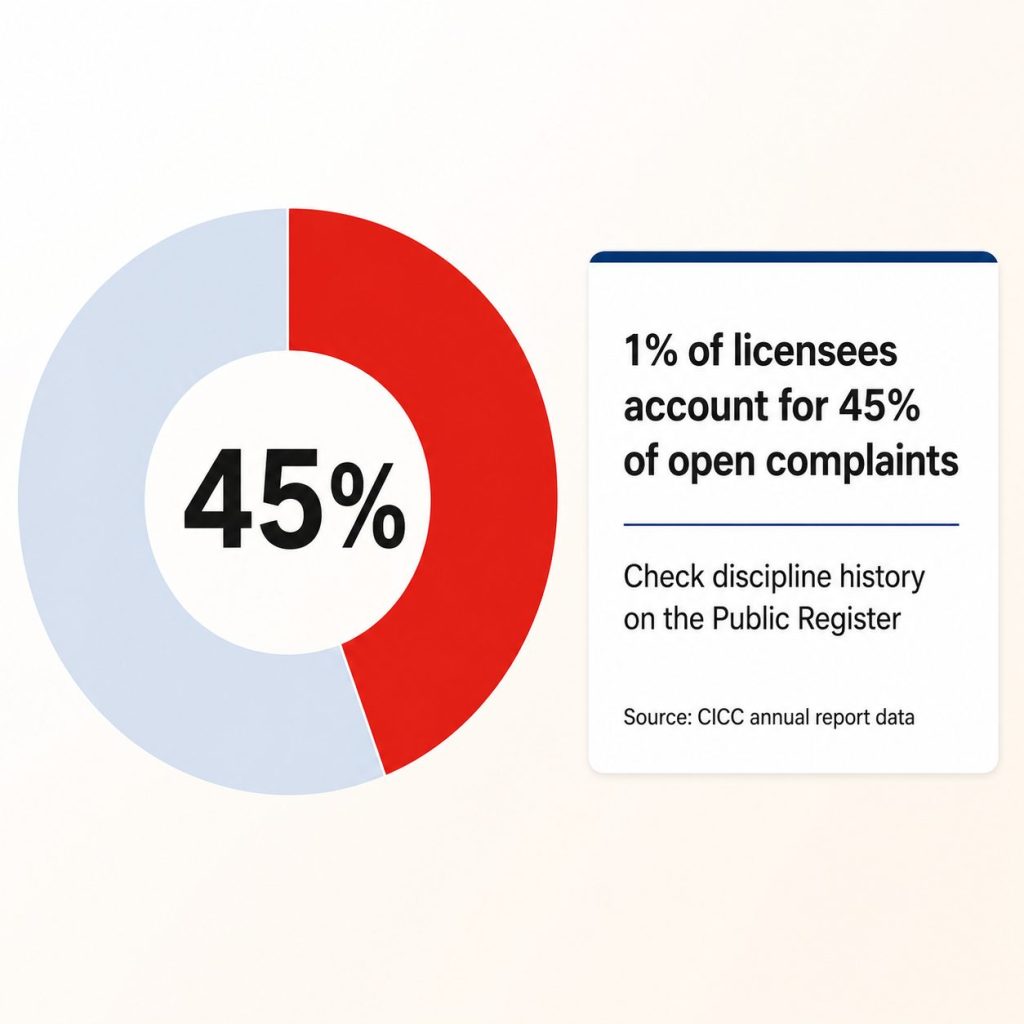
The Public Register shows discipline history for every licensee, and it’s worth reading. The College’s own data shows that the 1% of licensees with the most complaints account for 45% of open complaints, which tells you discipline problems are concentrated in a small group and that a clean history is meaningful. A licence alone is not a halo. In one 2024 case, a licensed Winnipeg consultant was convicted of counselling misrepresentation over fraudulent documents and fake job offers, fined $50,000, and barred from practice. The register would show you that.
Beyond the register, read reviews the way you would for any serious professional service, looking for patterns rather than single ratings. For representatives based in Canada, IRCC’s own guidance suggests checking the Better Business Bureau for complaint history. Any established practice should have a visible track record you can inspect, the way our clients’ reviews are public.
The oversight regime is also getting stronger. New federal regulations took effect on July 15, 2026, tightening the College’s oversight and discipline processes and creating a compensation fund for clients who suffer financial loss from a licensee’s dishonest conduct.
Expect a real assessment, not an instant yes
A proper assessment of your situation takes real time. There are more than 90 immigration pathways to Canada, and an honest professional has to understand your full history before recommending one, including the details that could complicate your case. Be cautious of anyone who declares you qualified after a quick fifteen minute call.
The profession’s own rules require the opposite of the instant yes. Under the CICC Code of Professional Conduct, if a consultant believes an application has little or no hope of success, they must tell the client so in writing, with reasons. Honesty about weak cases is a professional obligation, and in our experience it’s also the clearest signal of a consultant worth hiring. The people who tell you what you want to hear are rarely the ones who can deliver it, and they are often the first to look for reasons to stall and keep your money once it is clear they have brought you nothing.
Get everything in writing
The Code of Professional Conduct requires written agreements at two stages: a consultation agreement before even the initial consultation, and a service agreement before any further work. The service agreement must itemize the services for your specific case, the fees, estimated timeframes, the refund policy, and how complaints are handled. Advance payments must be held in trust, receipts are required, and every licensee must carry professional liability insurance.
That paper trail is your protection, and consumer protection is what the College’s mandate is built around. If someone wants to start work on a handshake, or asks for money before any agreement exists, the framework that protects you is missing, and that person is ignoring their own professional obligations.
Red Flags When Hiring an Immigration Consultant
The government’s own representative form states plainly that no one can guarantee the approval of your application. Hold every promise you hear against that sentence. The warning signs below come from the regulator’s rules and IRCC’s fraud guidance, and each one should end the conversation:
- Guaranteed approvals, “100% success rates,” or claimed special connections. The Code of Professional Conduct prohibits licensees from guaranteeing outcomes or implying special relationships with the government. Anyone making these claims is either unlicensed or breaking their own profession’s rules. A success rate on its own also tells you very little, so if someone quotes one, ask how many files it is based on.
- Promises of faster processing. No representative can speed up government processing or get your file special attention. What experience does change is the number of self-inflicted delays. A consultant who has learned what an officer actually needs to see can put a complete file in front of them the first time, which avoids the requests for more information that add months to a case. That is the honest version of this claim.
- An instant “you qualify.” As covered above, a real assessment takes time, and the Code requires written candour when chances are poor.
- Being told to leave the representative’s name off your forms. This is the signature move of a ghost consultant. Legitimate representatives are declared to the government on the Use of a Representative form (IMM 5476). If someone suggests this, or sets up a portal for you and submits your application without their name on it, run, do not walk.
- Cash-only payment, transfers to personal or third-party accounts, or pressure to pay before a written agreement exists. Advance payments belong in a regulated trust account, with receipts. This risk is exactly why we publish a notice to the public stating that we never accept cash or third-party wire transfers, only payments to our Canadian corporate account.
- Any suggestion to shade, omit, or invent information. The five-year misrepresentation ban lands on you, not the person who suggested it.
- “CICC member” branding, a licence number with no register match, or register contact details that do not match the person soliciting you. All three fail the same test: the Public Register is the source of truth.
Do I Need an Immigration Consultant or a Lawyer?
Both RCICs and immigration lawyers are authorized representatives, and for standard applications, either can represent you. The honest answer is that the right choice depends on your case, not on one profession being better than the other. A good rule of thumb is to hire the individual, not the profession.
| Regulated Canadian Immigration Consultant | Immigration lawyer | |
|---|---|---|
| Training | Graduate diploma in immigration and citizenship law, plus a national licensing exam | Law degree, plus provincial bar licensing |
| Regulator | College of Immigration and Citizenship Consultants | Provincial or territorial law society |
| Typical work | Applications, sponsorships, permits, citizenship; IRB hearings with the RCIC-IRB licence class | The same application work, plus court proceedings |
| Federal Court judicial review | Cannot represent you | Can represent you |
The clearest dividing line is the Federal Court. If a refused application needs to be challenged through judicial review, only a lawyer can represent you in that forum, and the filing deadlines are short. For sponsorships, permits, Express Entry, and citizenship applications, an experienced RCIC is a fully authorized specialist in exactly this work, and it is not necessary that they be able to represent you in Federal Court.
There are lawyers who do nothing but Federal Court work, and those are the specialists you would want in that situation. Many RCICs work closely with lawyers like that, and those relationships become a trusted source of referrals when a case needs to move in that direction. Whichever way you go, the vetting process is the same: verify the licence with the correct regulator, check the discipline history, and apply every test in this guide. The categories differ, but the standard does not.
Questions to Ask an Immigration Consultant Before You Sign
Bring this list to your first conversation. A good consultant will welcome every question on it:
- What is your licence number, and can I verify it on the CICC Public Register? Watch how they react. Pride is the right answer. Hesitation is not.
- Who will actually work on my file day to day? Some practices hand your case to junior staff after the sales call. You deserve to know who’s doing the work, which is why we introduce the Maple Team by name.
- What exactly does your fee include, and what would cost extra? The written service agreement must itemize this, so ask to see how they handle it.
- How will we communicate while the government processes my application, and how often will I hear from you? Long silences during processing are one of the most common complaints about representatives.
- Can I read the written agreement before paying anything? The answer must be yes.
- What is your honest read on my chances, and what could weaken my case? You’re testing for candour. A consultant who names the weaknesses in your case is showing you how they’ll treat you when it matters.
Hold Us to the Standard This Guide Teaches
Everything this guide warns against has the same antidote: a consultant who invites verification instead of dodging it, puts everything in writing, and tells you the truth even when it costs them the sale.
That’s the standard we built Maple Immigration Services around. Brandon’s licence, R507745, is on the CICC Public Register for you to check. Our practice has been a BBB Accredited Business since 2014 with an A+ rating, and we’re included in CourseCompare’s 2026 ranking of immigration consultants in Canada. We only take on cases we believe can succeed, and every consultation is documented in writing with a follow-up report, so you always know what we discussed and what comes next.
If you’re ready to talk through your situation with someone who will give you an honest answer, book a consultation with Brandon and The Maple Team, but verify us first. We insist.