By The Maple Team

A Canadian citizen living abroad can sponsor a spouse or partner without moving back first, as long as they’ll be living in Canada by the time the spouse becomes a permanent resident. A permanent resident living abroad currently can’t sponsor a spouse, because permanent residents have to be living in Canada to sponsor anyone.
If you’re a citizen, an officer at Immigration, Refugees and Citizenship Canada (IRCC), the department that decides sponsorships, has to be convinced that you’ll really move back. That can feel worrying, especially when you’re already apart from your spouse or planning a big move as a family, but really, IRCC wants to see steps you’ve already taken toward moving back, because a promise to move isn’t enough on its own.
Spousal and common-law partner sponsorship is one of the main focus areas at Maple Immigration Services, and when the sponsor lives outside Canada, their resettlement plan for moving back is one of the first things we work on together. Brandon Miller, the Regulated Canadian Immigration Consultant (RCIC) who leads our practice, knows this situation from his own life. He lived in the Philippines for eight years, running his businesses and starting his family there, before he moved back to Toronto while sponsoring his own wife and going through the system himself. That gives him a unique understanding of not only the professional side of the sponsorship process but also the very personal side.
Who can a Canadian citizen sponsor from abroad?
Sponsors normally have to live in Canada, but Canadian citizens have an exception that lets them sponsor a spouse, common-law partner, conjugal partner or dependent child from abroad, as long as the child doesn’t have children of their own. Section 130(2) of the Immigration and Refugee Protection Regulations says a citizen who “does not reside in Canada may sponsor” these family members “if the sponsor will reside in Canada when the foreign national becomes a permanent resident.” In practice, that means you can keep living abroad while the application is processed. A citizen living abroad currently can’t sponsor parents or grandparents.
If you plan to settle in Quebec, sponsoring from abroad is currently allowed there too, as long as you intend to live in Quebec once your spouse becomes a permanent resident. However, you’ll need to go through an added Quebec-specific process on top of the federal part of the application.
Living abroad doesn’t change the other sponsor requirements, such as being at least 18, and it doesn’t give you any break on the documents you need to provide. Our guide to whether you’re eligible to sponsor your spouse covers those and is worth a read. The residence rules in this article are about where you, the sponsor, live. Where your spouse lives during the application is a separate question that affects how you apply, which we explain in inland vs. outland spousal sponsorship.
Can a permanent resident living abroad sponsor a spouse?
A permanent resident living outside Canada currently can’t sponsor a spouse or partner, because the regulations require every sponsor to live in Canada and the exception above applies to citizens only. If you’re a permanent resident abroad, you would need to move back and be living in Canada before you apply. The one thing worth checking first is whether you actually count as living abroad, which the next section covers.
Do you count as living outside Canada?
If you’re a permanent resident working abroad for a set period, you may still count as living in Canada, which could mean you’re able to sponsor before your assignment ends. IRCC decides this by looking at where your principal residence is, meaning the home your life is actually based in. Its operational manual on assessing sponsors describes three situations:
- Short trips while your home is in Canada: sponsors who keep a principal residence in Canada still meet the requirement if they “take short holidays or business trips outside Canada on a temporary basis.”
- Temporary work assignments abroad: sponsors whose work takes them outside Canada “for temporary finite periods of time” still meet it, as long as they come back to live in Canada between assignments.
- Living abroad with short visits home: people who “do not maintain a principal residence in Canada and who live and work abroad … and only return to Canada for short visits are not considered to meet residency requirements.”
If your home is abroad and you come back to Canada only for visits, you’re in the third situation. As a citizen, that means you’ll need to show IRCC your plan to move back. As a permanent resident, it means you can’t sponsor until you’re living in Canada again.
Why does IRCC look so closely at your plan to return?
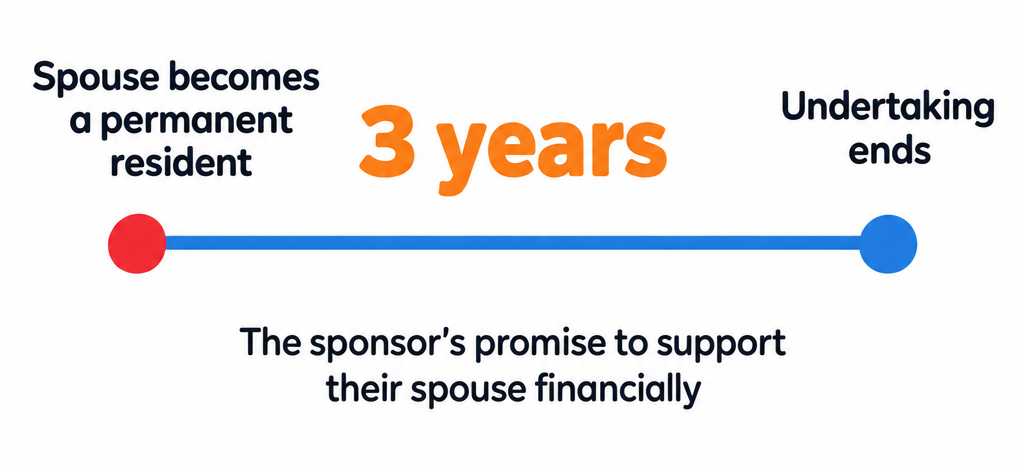
IRCC looks closely at your plan because sponsoring comes with a financial promise that IRCC expects you to keep while living in Canada. When you sponsor, you sign an undertaking, which is a promise to support your spouse financially. According to IRCC’s sponsorship guide, the undertaking for a spouse or partner lasts “3 years from the day your spouse, common-law partner or conjugal partner becomes a permanent resident.” IRCC’s operational manual adds that before approving a sponsor who lives abroad, the officer who decides the application has to be “satisfied that the sponsor will return to reside in Canada.”
Brandon explains the concern behind that rule:
“The government wants to see that you’re going to be able to come in here and that you’re not just going to drop your spouse off and then leave. Sometimes that’s what people do, so they want to make sure that you’re going to be able to support said individual and that everything’s going to be there.”
In our experience, your intent to reside in Canada is one of the most closely examined parts of a sponsorship when a citizen sponsors from outside Canada, and it’s one of the areas Brandon and the Maple Team focus on most. Officers often question it even when the sponsor has already sent a lot of supporting information with the application. Because it gets that much attention, a written statement that you’ll move back usually isn’t enough on its own, so you’ll need documents showing the move is already under way.
What proof shows IRCC you’ll move back to Canada?
The proof that tends to persuade an officer is evidence of steps you’ve already taken toward the move, such as lining up housing, work and school for your children, setting money aside for the move, and planning a timeline as part of a detailed, well-thought-out resettlement plan. IRCC doesn’t publish a checklist of these documents, so it’s up to you to choose what shows your move is real.
At Maple, we work this out with you as a migration and resettlement plan: where you’ll live, work and send your kids to school in Canada, and the documents that show the steps you’ve already taken toward each. Brandon describes it this way:
“We show that they’ve actually taken some steps, maybe to look at real estate, look at schools, and things along those lines.”
In our view, you don’t need to have bought a home or found a job in Canada before you apply, as long as you can show believable evidence of real steps you’ve taken toward the move.
Depending on your situation, that evidence might include:
- Housing: a lease, a home purchase, or arrangements to live with family in Canada
- Work: a job offer in Canada, a letter confirming a transfer, or job applications you’ve sent
- Children: school or daycare enrollment, or a plan for where your kids will go to school
- Finances: a Canadian bank account and money set aside for the move
- Your timeline: a letter explaining why you went abroad, why you’re coming back now, and when you expect to move
- Moving arrangements: quotes from moving companies
Treat these as examples of the usual minimum, not a complete checklist, since what belongs in your application depends on your circumstances.
Does every sponsor need the same proof?
Sponsors don’t all need the same proof, because the officer checks whether your evidence matches what the rest of your application says about your job, your family and your plans. Here are two hypothetical sponsors whose evidence would look quite different:
| Sponsor who keeps a remote job | Sponsor who resigns to find work in Canada | |
|---|---|---|
| Situation | Works remotely for a company abroad and will keep that job after moving | Is leaving their job in the country where they live now, then looking for work in Canada |
| Evidence that fits | Housing in Canada, and a letter from the employer confirming the job can be done from Canada | Job applications in Canada, savings to support the family during the job search, and a clear timeline |
The remote worker has no reason to apply for jobs in Canada, so a stack of Canadian job applications in their file would contradict the plan they’ve described. For the sponsor who’s resigning, job applications and savings show the officer how the family will manage until a new job starts.
Adding evidence that doesn’t fit your situation, just because it worked for someone else or looks stronger on paper, can backfire. If you’ve read about another couple’s sponsorship online, their situation was different from yours in ways that matter, so evidence that suited their application may not suit yours. Brandon warns about this:
“I also warn people not to try to make it look dodgy or out of context for their situation, because that actually makes it worse.”
This is a truly individual process. Every resettlement plan we put together is built for that specific client, so it makes sense and reflects their real situation and case.
Planning your move and your spouse’s sponsorship together
Waiting for IRCC to decide on your application is stressful, whether you’re living apart from your spouse or planning the move together. You can start working on your plan to move back now, before you even apply. If you’re still deciding whether to handle the application yourselves or work with a consultant, Immigration Start Guide’s comparison of a spousal sponsorship guide vs. an immigration consultant walks through the trade-offs. If you’d like help with it, tell us about your situation and we’ll set up a call to walk you through your move and how to show it to IRCC. You can also read more about how we approach spouse and partner sponsorship.