By The Maple Team

The quickest way to check if an immigration consultant is licensed in Canada is to look them up on the public register run by the College of Immigration and Citizenship Consultants (CICC), which licenses consultants in Canada. Each consultant’s entry has a column called “Entitled to Practise“, which shows whether they’re allowed to give immigration advice right now. Before you hire anyone, make sure that column says “Yes.” It’s also worth checking whether the College has ever disciplined them.
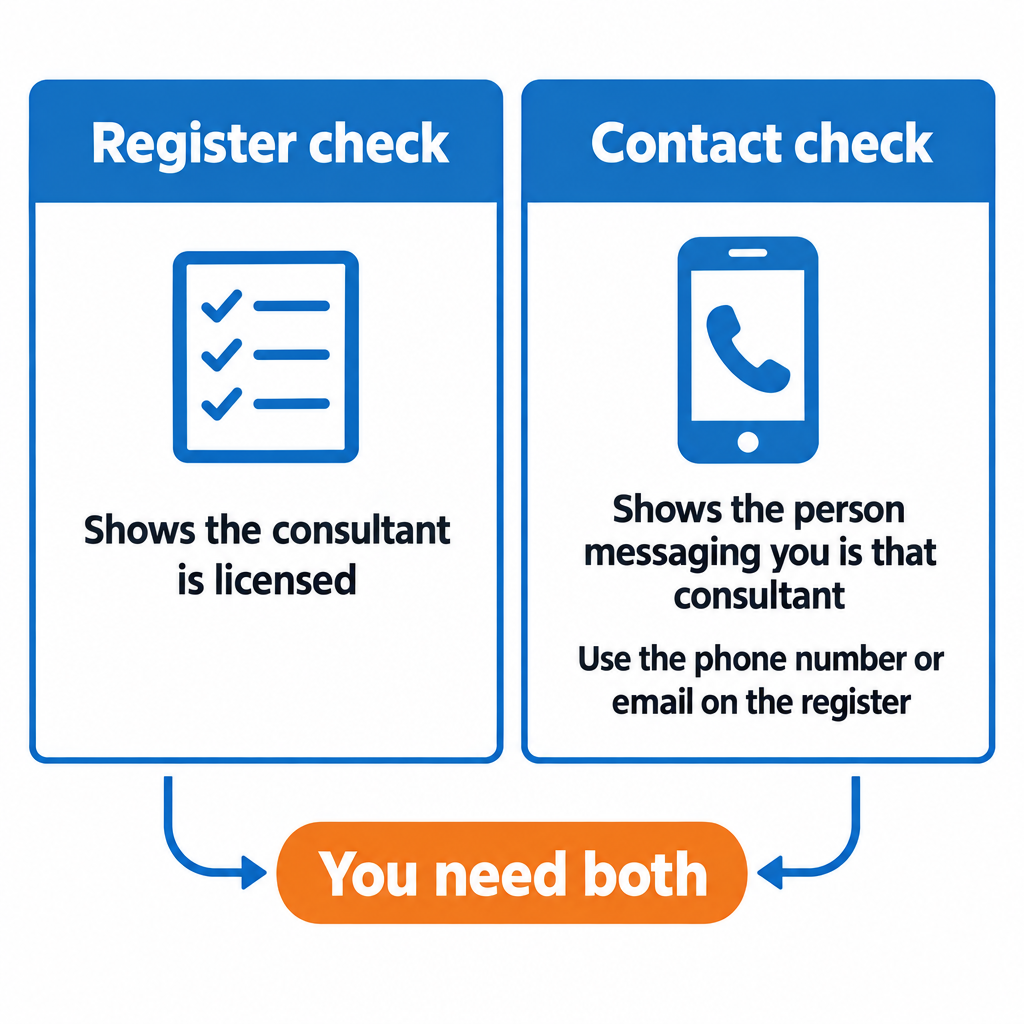
A licence on the register isn’t enough on its own, though, because people regularly pose as real consultants using their names and licence numbers. Before you pay anyone, contact the consultant through the phone number or email the register lists for them and confirm they’re the person you’ve been dealing with.
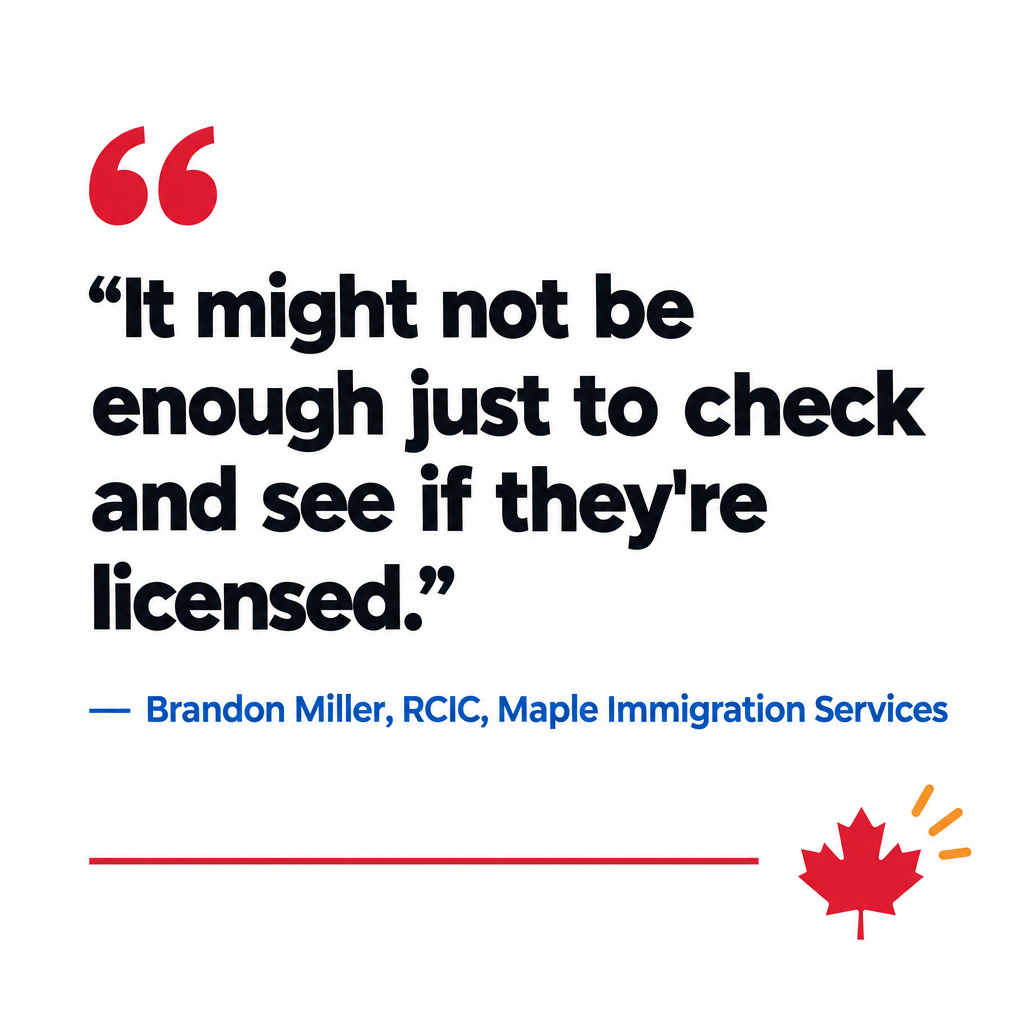
You’re about to hand over money and personal documents, so you’re right to check first. Brandon Miller, the Regulated Canadian Immigration Consultant (RCIC) at Maple Immigration Services, has volunteered with the CICC, taught new consultants, and has been very active in helping to shape the industry as it stands today. His advice is simple: “It might not be enough just to check and see if they’re licensed.”
Who is allowed to charge for immigration advice in Canada?
Only certain regulated professionals are allowed to charge you for Canadian immigration advice or to act as your paid representative. Immigration, Refugees and Citizenship Canada (IRCC) currently lists them as:
- Immigration consultants in good standing with the CICC
- Lawyers in good standing with a Canadian provincial or territorial law society
- Paralegals in good standing with the Law Society of Ontario (IRCC’s list of authorized representatives currently names only Ontario paralegals)*
- Notaries in good standing with the Chambre des notaires du Québec
IRCC’s Use of a Representative form page also allows students-at-law to act under the supervision of a lawyer, paralegal or Quebec notary. Anyone else who charges you for this help is not authorized, and IRCC’s advice is that you should not use their services. A friend or family member who helps you for free doesn’t need a licence. If the person you’re dealing with says they’re a lawyer, you check them with their provincial or territorial law society instead of the CICC.
*A note on paralegals: an Ontario paralegal’s role in immigration is much narrower than a consultant’s or a lawyer’s. Under the Law Society of Ontario’s By-Law 4, a paralegal can currently represent you only in proceedings before a tribunal, such as a refugee hearing or an immigration appeal at the Immigration and Refugee Board (IRB), and prepare the documents for those proceedings. A paralegal is not allowed to prepare or submit an application to IRCC for you, and Ontario’s Court of Appeal confirmed that limit in October 2026. The exception is a paralegal who is also licensed with the CICC as an immigration consultant, which you can check on the CICC register.
How to check an immigration consultant’s licence on the CICC register
You check a consultant’s licence by searching for them on the CICC Public Register and reading their entry and profile closely. It takes a few minutes:
- Ask the consultant for their College ID. The College ID is their licence number, and a licensed consultant should give it to you without any hesitation. Brandon’s, for example, is R507745, and you’re welcome to look it up.
- Search the register. Searching by College ID is the most precise way to find someone. If you only have a name, you can search by first and last name, and you can also search by company name, country or city.
- Check the Entitled to Practise column. Only a “Yes” here means the person can currently give you immigration advice or services.
- Check the status. The status explains the Yes or No in the Entitled to Practise column. “Active” is what you want to see, and the next section explains what the other statuses mean.
- Check that the company matches. The register lists the company each consultant works under, so the business you’re dealing with should be the one shown there.
- Open the full profile. The profile shows the consultant’s current licence class and status, when they were first licensed, any suspension or revocation history, and the company, email and phone number the consultant has registered with the College.
If you can’t find the person at all, or the name, company or contact details don’t match what you’ve been told, stop there. Don’t send any money or documents, and report it to the appropriate authorities (the reporting section further down lists where to go).
What the CICC licence statuses mean
Only two statuses come with a “Yes” under Entitled to Practise, and the CICC describes the statuses you’ll see like this:
| Status | Entitled to Practise | What it means |
|---|---|---|
| Active | ✓ Yes | In good standing and authorized to provide immigration advice and services |
| Active – Practice Restricted | ✓ Yes | Can practise, with limits set by the College. The register shows those limits next to the status. |
| Leave of Absence | ✗ No | On leave for a set period and has agreed not to provide services |
| Resigned | ✗ No | Has given up their licence |
| Administrative Suspension | ✗ No | Didn’t meet an administrative obligation, such as paying fees or completing required training hours |
| Administrative Revocation | ✗ No | The College revoked the licence because the consultant didn’t fix an administrative suspension within 90 days |
| Disciplinary Suspension | ✗ No | Suspended through the College’s disciplinary process |
| Disciplinary Revocation | ✗ No | Licence revoked through the College’s disciplinary process |
A restricted consultant can still legally take on your case, so read what the restriction says and ask them about it before you decide whether you’re comfortable going ahead.
How to check a consultant’s disciplinary record
To check a consultant’s disciplinary record, start with the Suspension-Revocation History on their register profile, then search for their name on the CICC’s three discipline lists:
- Revocations, Suspensions and Restrictions
- Current Proceedings, for cases that haven’t been decided yet
- Past Decisions
These lists show whether the College has taken action against the consultant in the past or has a case open against them now. Brandon suggests checking them along with the licence: “The other thing that you might want to check out is their record. You can see about the disciplinary proceedings or a lot of the tribunal work that’s already on there as well.”
A clean record is a good sign, but the register can’t tell you how a consultant treats their clients day to day. For that, the CICC suggests asking the consultant for references from past clients.
Does the licence number tell you how long a consultant has been practising?
A consultant’s licence number doesn’t tell you how long they’ve been practising, but their register profile does. Look at the Initial Licence start date on the profile, which shows when the consultant was first licensed, and the Licence History beneath it.
The licence class also tells you whether a consultant is new to the profession. You’ll find it under Type on the register, and these are the classes the CICC currently uses for consultants:
| Class | What it means |
|---|---|
| L1 | In their first year and still completing the CICC’s mentoring program for new consultants |
| L2 | Has finished the mentoring program, or was licensed early enough not to need it |
| L3 | The same as L2, and can also represent clients at the Immigration and Refugee Board (IRB) |
Time on the register still doesn’t tell you whether someone has handled a case like yours. “You want to make sure that you’re getting somebody who not only has a licence but also has the experience for your case,” Brandon says. How your application goes depends on your own situation, so a case you read about online won’t tell you much about yours. Ask the consultant directly how often they work on applications like yours and what tends to go wrong with them.
Time in the profession and how active a consultant is can tell you a lot, but the licence class on its own isn’t a measure of expertise. Brandon, for example, has chosen not to pursue the L3 class. He doesn’t intend to represent clients before the IRB, because that’s a specialized area of practice, and he believes the best professionals specialize and “stick in their lane” so they’re true experts in the areas they practise in.
How do you know you’re talking to the real consultant?
The only way to be sure you’re talking to the real consultant is to contact them yourself, using the phone number or email on their CICC register profile, and to speak with them before you pay. A clean register check proves that the consultant exists, but it can’t prove that the person messaging you is that consultant. The CICC warns on its fraud prevention page that “Impersonating an immigration consultant is a common form of fraud.”
“There are a lot of people that will masquerade as licensed consultants, and they will use people’s identities,” Brandon says. “If you’re communicating with somebody who is on WhatsApp and you haven’t seen them, or you’re speaking to somebody who says they’re an agent, you certainly want to make sure that you’re speaking to the right person.” It happens to our own practice, too:
“We have calls that will come to our office where people will say that they’re our client when, in fact, we don’t know who they are. They’ve paid some guy in crypto to work with us, and they said that they’re working with us. Unfortunately, that happens quite often, where people will even steal the consultant’s identity,” Brandon says.
The CICC also recommends contacting the consultant who will actually handle your application directly. “If you’re going to be spending lots of money, pick up the phone and speak to them,” Brandon says.
Warning signs of a fake or unlicensed immigration consultant

Any of these should make you stop and check again before going any further, even if the person’s name checks out on the register:
- They won’t give you their College ID, or the number they give you doesn’t match the name and company on the register.
- They only talk to you over WhatsApp or another chat app and avoid a phone or video call.
- They call themselves an “agent” for a consultant you never get to speak with.
- They want payment in crypto, gift cards or cash, or sent to a personal account. A licensed practice will normally have a business account in its own name. At Maple, for example, we only take payment into our Canadian corporate account and never accept cash or third-party wire transfers, which we explain in our notice to the public.
- They don’t want to be named on your application. IRCC currently requires any paid representative to be named on its Use of a Representative form (IMM 5476), which goes in with your application. If a paid representative isn’t in good standing, IRCC says “your application will be returned,” so someone who isn’t licensed has a reason to keep their name off the form. A person who takes your money but stays off the form is often called a ghost consultant.
- They suggest false information or documents. Your signature is on the application, so you’re the one responsible for anything false in it, even if someone else suggested it. Licensed consultants have to follow a set of rules called the CICC’s Code of Professional Conduct. “If they’re not following the rules, or they’re suggesting that they’re going to go against something like their code of ethics, maybe you might want to find somebody else,” Brandon says.
- They promise an approval. IRCC makes the decision on every application, so nobody can honestly guarantee you an outcome.
What to do if you’ve already paid a fake immigration consultant
If you’ve already paid someone who turns out to be fake or unlicensed, report it as soon as you can. IRCC says its goal is to stop the people committing the fraud, rather than to punish the people they misled. Where you report depends on what happened:
- If the person helped with your application or is named on it, report them to IRCC through its online form.
- For immigration fraud, fake documents or misconduct by a representative, you can also call the Canada Border Services Agency (CBSA) Border Watch Line.
- If they claimed to be a licensed consultant, file a complaint with the CICC through a College Portal account. The College currently takes complaints only online, and its ability to help you get money back is limited, so getting a refund may mean going to civil court.
- If they claimed to be a lawyer or paralegal, complain to their provincial or territorial law society.
- For scams that happened online, by phone or by text, report to the Canadian Anti-Fraud Centre.
- If you gave them personal or financial information, tell your local police.
If an application has already been submitted with that person attached to it, you can use a new IMM 5476 form to cancel them as your representative or name a new one.
Talk to a consultant you can verify
If you’ve been talking to someone and something doesn’t feel right, or you’d simply like to work with a consultant you can check for yourself before you pay a cent, we’d be glad to hear from you. Tell us about your situation and we’ll set up a call to walk through it with you.